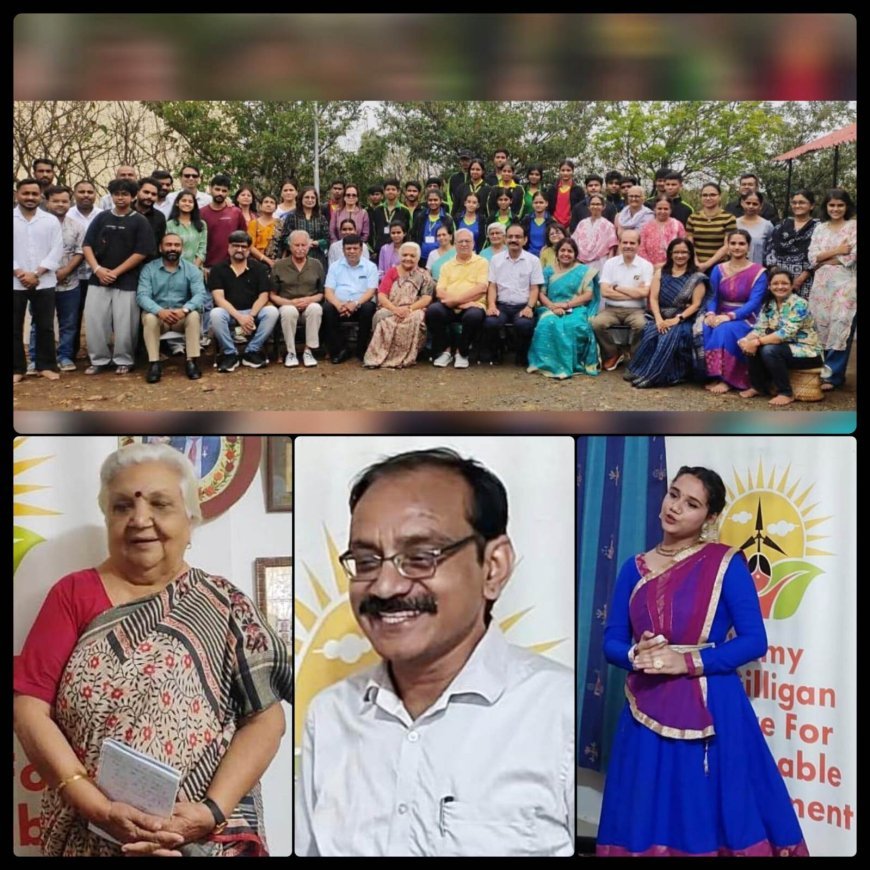
World Environment Day discourse in Indore concludes with call for zero-waste climate action
The week-long environmental discourse concluded at the Jimmy McGilligan Centre for Sustainable Development, Sanawadiya, with a World Environment Day programme that focused on climate action, sustainable living and community-driven environmental responsibility.
Students from Intellect Heights Academy participated in discussions on climate action, environmental conservation and sustainable development, with sessions designed to connect awareness with practical behavioural change.
The programme began with conch blowing and prayers led by Virendra Goel and Janak Palta McGilligan, followed by a Kathak performance by Nitya Batra. The performance highlighted the relationship between humans and nature and conveyed the need for ecological balance.
Discourse and Reporting
Padma Shri Janak Palta McGilligan presented a detailed report on the week-long environmental discourse. She outlined that the sessions covered climate action for public health, sustainable livelihoods, clean water and air, community development, and waste reduction. She stated that the intention of the programme was to convert environmental learning into measurable community action.
“The discourse was structured to build awareness and encourage practical climate action that individuals can adopt in their daily lives. Participants were encouraged to link environmental responsibility with long-term sustainable practices.”
— Padma Shri Janak Palta McGilligan
Ranjana Goswami, addressing the gathering, emphasised that environmental awareness and scientific understanding are necessary to address current ecological challenges. She said students must become informed decision-makers and adopt sustainable lifestyles to respond to climate risks effectively.
In her remarks, she noted that environmental education should not remain theoretical and must translate into daily behavioural change.
Institutional Initiatives
Yogesh Goswami highlighted institutional initiatives including tree plantation drives, campus greening activities and sustainability-focused programmes. He said educational institutions play a critical role in shaping environmentally responsible citizens.
He stated that such initiatives help build long-term environmental consciousness among young learners.
Community Commitments
Participants collectively discussed climate action aligned with United Nations Environment Programme goals. The commitments included reducing single-use plastics, adopting reusable materials such as cloth and steel alternatives, and promoting biodegradable inputs.
Other actions discussed included developing terrace gardens, reducing unnecessary consumption including clothing purchases, adopting plastic-free kitchen practices, carrying reusable steel utensils, improving water and energy efficiency, and switching off electrical appliances when not in use.
The group also emphasised planting trees and nurturing them for at least five years, reducing medical waste in healthcare settings, and adopting solar thermal cookers for sustainable energy use.
Padma Shri Janak Palta McGilligan stated that the programme operated on a zero-budget and zero-waste model, reinforcing practical sustainability at every stage of execution.
Virendra Goel delivered the vote of thanks, expressing appreciation to all participants, educators, volunteers and contributors for their involvement in the climate action programme.
The event concluded with a collective appeal for sustained climate action, with emphasis on individual responsibility, community participation and long-term environmental stewardship aimed at achieving sustainable development goals.
- Zero-Impact Execution: Fully executed under a zero-budget and completely zero-waste structural blueprint to model actionable low-impact living.
- Material Substitutions: Active rejection of single-use plastics in favour of biodegradable inputs, cloth textiles, and reusable steel utensils.
- Eco-Domestic Frameworks: Expanding micro-agriculture with terrace gardens, establishing plastic-free kitchen systems, and curtailing fast-fashion clothing consumption.
- Long-Term Afforestation: Commitments to structural tree planting drives requiring an absolute minimum upkeep and nurturing phase of five years.
- Resource Optimisation: Lowering medical waste parameters across healthcare nodes, integrating solar thermal cookers, and monitoring daily electricity and fluid utilities.