Featured image: SGSITS Indore space technology interaction
From Indore to Space: SGSITS Launches MP’s First AI, ML and Satellite Communication M.Tech Programme
Indore: India’s next space revolution will not be powered only by rockets and satellites — it will be driven by engineers who can make these technologies intelligent. Recognising this emerging need, Shri Govindram Seksaria Institute of Technology and Science (SGSITS), Indore, has introduced Madhya Pradesh’s first M.Tech. programme in Intelligent Communication System (ICS), integrating Artificial Intelligence (AI), Machine Learning (ML) and satellite communication technologies.
The programme marks a significant shift in engineering education by bringing together electronics, communication systems, artificial intelligence and space technology under one specialised academic framework.
As satellites become central to agriculture monitoring, environmental protection, disaster management, defence applications, navigation, healthcare services and infrastructure planning, the ability to process satellite-generated data intelligently has become one of the most important technology challenges of the coming decade.
SGSITS Indore’s initiative aims to prepare engineers who can contribute to this transformation — through careers in organisations such as ISRO and DRDO, private space companies, research institutions and technology startups.
- First M.Tech. Intelligent Communication System programme in Madhya Pradesh
- Combines AI, Machine Learning and satellite communication
- Focuses on practical projects, satellite applications and intelligent systems
- Creates pathways for careers in space technology, defence and startups
Why AI and Space Technology Are Becoming India’s Next Big Opportunity
The global space sector is undergoing a fundamental transformation. Space technology is no longer limited to government missions or scientific exploration; it has become a critical technology platform supporting economic development, national security and public services.
India’s space ecosystem is also expanding rapidly with increased participation from private companies, startups and academic institutions. Areas such as satellite manufacturing, earth observation, launch services, communication satellites and space-based applications are attracting new investments and innovation.
The establishment of the Indian National Space Promotion and Authorization Centre (IN-SPACe) has accelerated private participation by creating a framework for non-government entities to contribute to India’s space activities.
According to government policy vision, India aims to significantly increase its presence in the global space economy by encouraging innovation, private enterprise and technology development.
The New Space Engineer: Where Electronics Meets Artificial Intelligence
Future space missions will require engineers who understand not only hardware but also intelligence. Satellites generate enormous volumes of information, and Artificial Intelligence helps convert this data into meaningful decisions.
AI and Machine Learning are increasingly being used in:
- Satellite image processing and remote sensing analysis
- Automatic detection of changes on Earth’s surface
- Weather and climate monitoring
- Communication network optimisation
- Autonomous satellite operations
- Defence and surveillance applications
This combination of electronics, communication engineering and artificial intelligence is creating demand for a new category of professionals — engineers who can work at the intersection of space systems and intelligent technologies.
SGSITS Indore Creates a New Academic Pathway
The Department of Electronics and Telecommunication Engineering at SGSITS has designed the M.Tech. Intelligent Communication System programme to address this emerging requirement.
Prof. S. K. Jain, Head of the Department of Electronics and Telecommunication Engineering, SGSITS Indore, said the programme represents a new direction for engineering education in Madhya Pradesh.
“This is the first M.Tech. programme in Intelligent Communication System in Madhya Pradesh. It involves Artificial Intelligence, Machine Learning and project work related to satellite activities.”
— Prof. S. K. Jain, Head, Department of Electronics and Telecommunication Engineering, SGSITS Indore
The programme has been structured to provide students exposure to advanced communication technologies, satellite applications, AI-based solutions and research-oriented projects.
India’s Space Economy and the Rise of Private Innovation
India’s space sector is moving from a government-led ecosystem towards a broader innovation-driven model where startups, industries, universities and research institutions are becoming important contributors.
The policy changes introduced in recent years have opened opportunities for private players in satellite manufacturing, launch services, space applications, earth observation and communication technologies.
The growth of this ecosystem is creating demand for engineers with specialised skills in areas such as satellite communication, artificial intelligence, electronics, robotics, data analytics and advanced computing.
For engineering students, this shift means that space technology is no longer limited to a few traditional career paths. New opportunities are emerging across research organisations, technology companies and entrepreneurial ventures.
The role of institutions like SGSITS becomes important because the future workforce will need interdisciplinary knowledge — combining electronics and communication fundamentals with AI-based problem-solving abilities.
Dr. Vinod Kumar Highlights Growing Opportunities in Space Technology
Recently, SGSITS Indore hosted an expert interaction on space technology where Dr. Vinod Kumar, Promotion Director, IN-SPACe (Indian National Space Promotion and Authorization Centre), shared insights on India's evolving space ecosystem and opportunities for students.
The session was organised by Darshnil Foundation in association with Moon Originated Derivative Inventions Pvt. Ltd. at the Electronics and Telecommunication Engineering Department of SGSITS.
Dr. Vinod Kumar explained that space technology today is not restricted to satellites and missions alone. It has become an important part of everyday life, influencing agriculture, infrastructure planning, resource management, navigation and public services.
Space technology has moved beyond exploration and is now becoming a powerful tool for solving real-world challenges through data, communication and intelligent applications.
During the interaction, he highlighted how satellite-based technologies are supporting initiatives such as infrastructure development, logistics management, environmental monitoring and resource planning.
He also explained the importance of India's space policy framework, technology transfer opportunities, startup support mechanisms and increasing private participation in the sector.
Space Technology Applications Changing Life on Earth
The discussion highlighted how satellite technology is contributing to multiple sectors:
- Agriculture: Crop monitoring, precision farming and resource assessment through satellite imagery.
- Environment: Monitoring climate changes, pollution levels and ecological patterns.
- Water Management: Tracking water resources and supporting sustainable planning.
- Disaster Management: Early assessment and response during floods, cyclones and natural emergencies.
- Healthcare: Supporting connectivity and remote services in difficult geographical regions.
- Navigation: Enabling location-based services and communication networks.
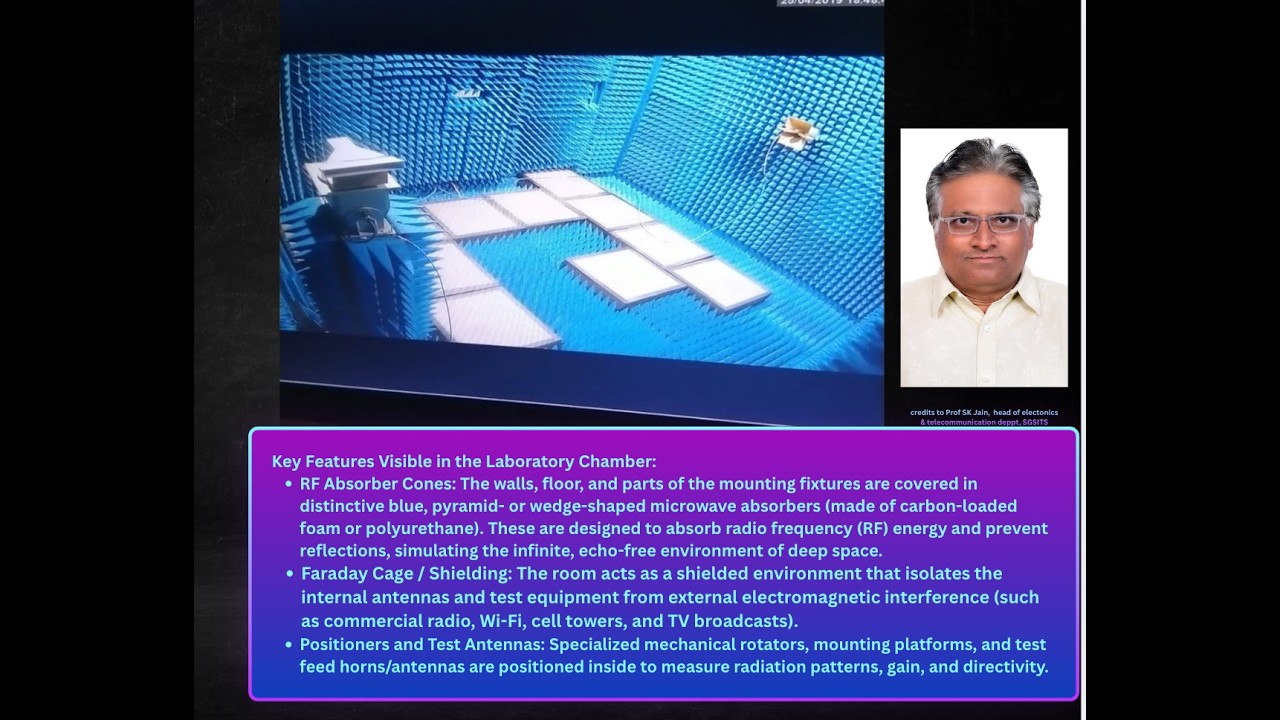
Advanced Infrastructure at SGSITS for Satellite Communication Research
A specialised technology programme requires strong research infrastructure. SGSITS Indore has developed facilities to support advanced work in communication systems, antenna technology and satellite applications.
Prof. S. K. Jain explained that the department has dedicated laboratory facilities for students working in this area.
“We have a dedicated RF and Microwave Satellite Antenna Laboratory with an 18 GHz testing facility.”
— Prof. S. K. Jain, SGSITS Indore
The laboratory infrastructure allows students to work on antenna design, microwave systems, communication technologies and practical satellite-related projects.
Such facilities provide students with exposure beyond classroom learning and help them understand how theoretical concepts are applied in real engineering systems.
Academic Collaboration with IIT Indore and ISRO
Technology development requires collaboration between institutions. SGSITS has been strengthening its academic ecosystem through partnerships and research activities.
Prof. Jain said that the department has collaboration with the Space Department of IIT Indore and its Antenna Testing Laboratory .
The department is also involved in in-house nano-satellite activities with ISRO, giving students exposure to practical aspects of satellite systems.
Such collaborations create opportunities for students to understand testing procedures, communication systems, satellite components and real-world engineering challenges.
Students Designing AI-Based Satellite Solutions
The programme is already encouraging students to explore applications where artificial intelligence meets satellite technology.
“Our students are designing satellite antennas using Artificial Intelligence and Machine Learning.”
— Prof. S. K. Jain
Students are also involved in satellite communication and remote sensing activities through the department’s chapter of the Indian Society of Remote Sensing.
The department has in-house software support for satellite data analysis, allowing students to understand how information collected from space can be processed for practical applications.
Watch the Expert Interaction on Space Technology at SGSITS Indore
The expert session gave students insights into India's space ecosystem, emerging technologies, career opportunities and the role of young engineers in building future space solutions.
Career Opportunities After M.Tech. Intelligent Communication System
The combination of Artificial Intelligence, Machine Learning, electronics and satellite communication is creating a new category of technology professionals. Graduates trained in these areas can contribute to several emerging domains in India’s technology ecosystem.
The programme at SGSITS Indore is designed to prepare students for opportunities in government organisations, private industries, research institutions and entrepreneurship.
| Skill Area | Potential Career Opportunities |
|---|---|
| Satellite Communication | Satellite Communication Engineer, Communication System Specialist |
| RF and Microwave Technology | RF Engineer, Antenna Design Engineer, Microwave Research Professional |
| Artificial Intelligence and Machine Learning | AI Engineer, Satellite Data Analyst, Remote Sensing Specialist |
| Defence Communication | Research Opportunities in Defence Technology Organisations |
| Space Entrepreneurship | Space Startup Founder, Technology Innovator, Application Developer |
From Classroom Learning to Space Startups
The changing space ecosystem is also opening opportunities for entrepreneurship. Students with technical knowledge and innovative ideas can develop solutions for satellite applications, remote sensing, communication services and data-driven technologies.
The government’s encouragement of private participation has created an environment where young engineers can move beyond traditional employment and explore startup opportunities.
Areas such as agricultural intelligence, climate monitoring, satellite analytics, navigation services and communication solutions are creating possibilities for technology entrepreneurs.
With the right combination of engineering skills, research exposure and innovation mindset, graduates can contribute not only as employees but also as creators of new space technology solutions.
Why This Programme Matters for Students
- Provides exposure to emerging technologies combining AI and space systems.
- Creates opportunities for research-based learning.
- Develops skills relevant to future technology industries.
- Connects electronics engineering with real-world satellite applications.
- Encourages innovation and startup thinking.
Exclusive Interview: Prof. S. K. Jain, Head, Department of Electronics and Telecommunication Engineering, SGSITS Indore
In an exclusive interaction, Prof. S. K. Jain shared details about the vision behind the M.Tech. Intelligent Communication System programme, research facilities, collaborations and future opportunities for students in the space technology sector.
Q1. Is this the first M.Tech. programme in Madhya Pradesh combining AI/ML with space communication?
Prof. S. K. Jain:
Yes, it is the first M.Tech. programme in Intelligent Communication System in Madhya Pradesh. It involves Artificial Intelligence, Machine Learning and project work related to satellite activity.
The programme is designed to provide students with knowledge of intelligent communication systems and their applications in advanced technology areas.
Q2. How many students are currently enrolled in this programme?
Prof. S. K. Jain:
We have 12 seats in this M.Tech. programme. The admission process is ongoing.
Q3. Are there dedicated laboratories and projects related to satellite communication or AI applications?
Prof. S. K. Jain:
Yes, we have a dedicated RF and Microwave Satellite Antenna Laboratory with an 18 GHz testing facility.
The facility supports advanced work related to communication systems, antenna technologies and satellite applications.
Q4. Are collaborations planned with ISRO, IN-SPACe, private space companies or startups?
Prof. S. K. Jain:
Yes, we have collaboration with the Space Department of IIT Indore Antenna Testing Laboratory.
We also have collaboration with ISRO for nano-satellite in-house activity.
Q5. How many students could potentially enter this sector annually?
Prof. S. K. Jain:
It depends on the industry and ISRO, DRDO requirements. But since the government has allowed space technology startups, jobs will be created in this sector.
The growth of private participation in space technology will create more opportunities for skilled engineers.
Q6. Are students already working on projects using satellite data?
Prof. S. K. Jain:
Our students are designing satellite antennas using Artificial Intelligence and Machine Learning.
We have a chapter of the Indian Society of Remote Sensing. Students work on various aspects of satellite communication data.
We have in-house software support to analyse satellite data.
Related SGSITS Stories on Tinakhatri.in
Also Read: SGSITS Indore’s growing industry collaboration ecosystem and technology initiatives
Read More: SGSITS research and innovation initiatives receive major support
The Future of Engineering Education: Preparing Students for the Space Age
The emergence of programmes like M.Tech. Intelligent Communication System reflects a larger transformation taking place in engineering education. The boundaries between electronics, computer science, artificial intelligence and space technology are becoming increasingly interconnected.
The engineers of tomorrow will not work in isolated technology domains. A satellite engineer may need knowledge of communication systems, artificial intelligence, data analytics and autonomous technologies. Similarly, an AI professional may need an understanding of the physical systems generating the data being analysed.
This interdisciplinary approach is becoming essential as India moves towards advanced applications of space technology for national development.
Institutions that combine academic learning with practical exposure, research collaboration and industry engagement will play an important role in creating this future workforce.
Why Indore Could Become a Centre for Emerging Technology Talent
Indore has increasingly emerged as an important education and innovation hub in central India. With institutions focusing on engineering research, technology development and entrepreneurship, the city is creating a stronger ecosystem for future technologies.
The introduction of an AI and space communication-focused postgraduate programme at SGSITS adds another dimension to this ecosystem by connecting local talent with national technology opportunities.
The combination of academic institutions, research collaborations and growing industry interest can help create a pathway where students from Madhya Pradesh participate in sectors traditionally considered concentrated in major technology centres.
For students aspiring to enter the space sector, access to specialised education closer to home can become an important advantage.
Frequently Asked Questions (FAQ)
What is the M.Tech. Intelligent Communication System programme at SGSITS Indore?
The M.Tech. Intelligent Communication System programme at SGSITS Indore is a specialised postgraduate programme combining Artificial Intelligence, Machine Learning, communication engineering and satellite technology applications.
Is SGSITS Indore’s Intelligent Communication System programme the first of its kind in Madhya Pradesh?
According to Prof. S. K. Jain, Head of the Department of Electronics and Telecommunication Engineering, it is the first M.Tech. programme in Intelligent Communication System in Madhya Pradesh.
Can electronics and communication engineers work in the space sector?
Yes. Electronics and communication engineers play an important role in satellite communication, antenna design, RF systems, navigation technology, telemetry systems and communication networks.
How is Artificial Intelligence used in satellite technology?
Artificial Intelligence helps analyse satellite data, improve communication efficiency, support remote sensing applications, enable automation and assist decision-making using large volumes of information generated by satellites.
What career opportunities can students explore after this programme?
Students can explore opportunities in organisations such as ISRO, DRDO, private space companies, research institutions, communication industries and space technology startups.
Does SGSITS have facilities for satellite communication research?
Yes. SGSITS has a dedicated RF and Microwave Satellite Antenna Laboratory with an 18 GHz testing facility and supports student projects related to communication and satellite applications.
Official Sources and Reference Links
The information in this article has been prepared using institutional details and official technology ecosystem references.
- SGSITS Indore Official Website
- Indian Space Research Organisation (ISRO)
- IN-SPACe Official Website
- Defence Research and Development Organisation (DRDO)
- Indian Institute of Technology Indore
Editorial Note
This feature is based on an exclusive interaction with Prof. S. K. Jain, Head, Department of Electronics and Telecommunication Engineering, SGSITS Indore, and insights shared during a space technology expert session featuring Dr. Vinod Kumar, Promotion Director, IN-SPACe.
The article aims to highlight the changing landscape of engineering education, India’s growing space ecosystem and the opportunities emerging at the intersection of Artificial Intelligence, Machine Learning and satellite technology.
Final Word: Building Engineers for India’s Space Future
The launch of Madhya Pradesh’s first M.Tech. programme in Intelligent Communication System at SGSITS Indore represents a significant step towards preparing engineers for a technology landscape that is rapidly changing.
The next generation of space technology will depend not only on advanced satellites and launch systems but also on the intelligence, algorithms and communication networks that make these systems more powerful and useful.
By bringing together Artificial Intelligence, Machine Learning and satellite communication, SGSITS Indore is creating an opportunity for students to participate in one of the most exciting technology journeys of the coming decades.
For Indore and Madhya Pradesh, this is more than an academic programme. It is a step towards building a talent ecosystem capable of contributing to India’s ambitions in space, defence, communication and innovation.
Published by Tinakhatri.in | Technology & Innovation Feature