The Voice Through Touch: The Inspiring Story of Deafblind Advocate Zamir Dhale
When a room goes dark, a person can still listen for a voice. When a room falls silent, a person can still look around for a sign. But when both light and sound vanish, the world transforms into a vast, uncharted quiet.
For Zamir Dhale, born Deaf in Nashik, Maharashtra, and facing severe vision loss by the age of nine, this double sensory barrier became the foundation of an extraordinary life mission. Today, he stands as one of India’s most prominent disability rights advocates, proving that deafblindness is not an obstacle to education, leadership, or social contribution.
How Zamir "Speaks" and Communicates with an Audience
To understand Zamir's public addresses, one must first understand how he communicates. Zamir does not speak with an auditory voice, nor can he hear an audience.
Instead, he presents his speeches using rapid Indian Sign Language (ISL). A trained sign language interpreter standing beside him watches his hands in real time and voices his exact words into a microphone for the audience.
When someone in the crowd asks a question or responds, communication flows back to Zamir through two primary methods:
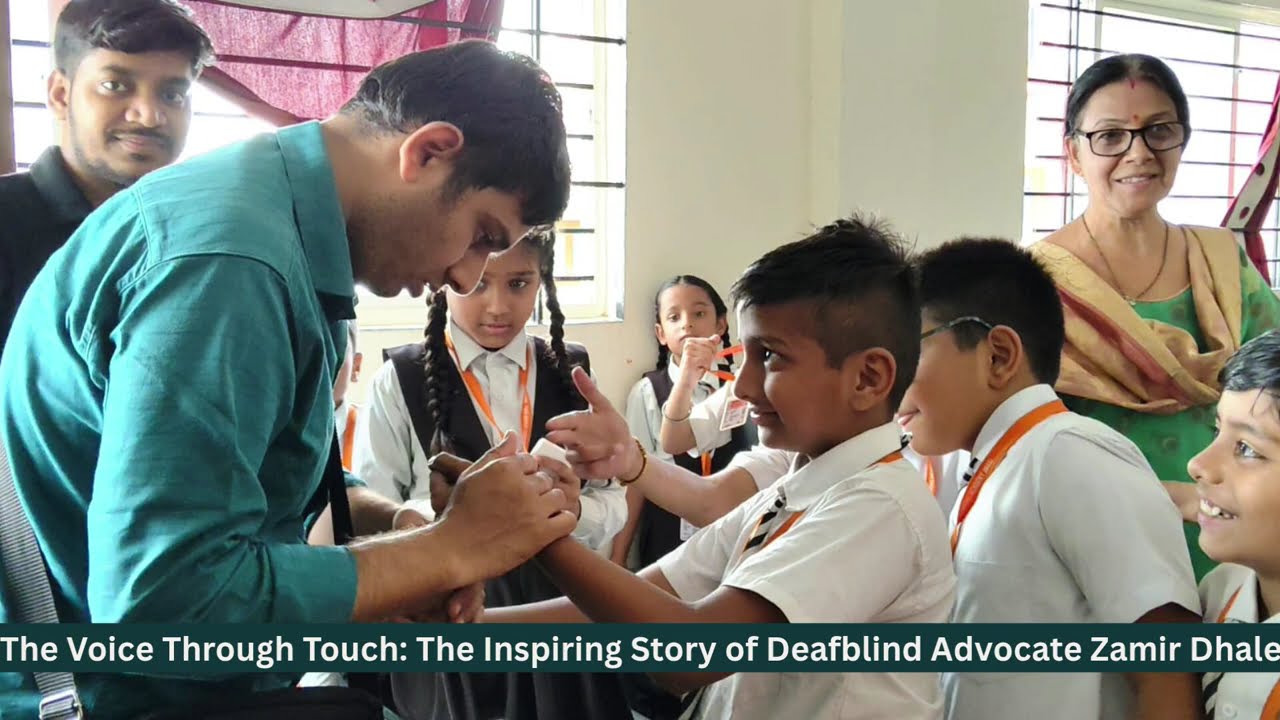
- Tactile Sign Language: A tactile interpreter holds Zamir's hands, signing spoken words directly into his palms. By feeling the pressure, direction, and shape of the hands, Zamir understands the message instantly.
- Refreshable Braille Displays: Questions or text are typed into a digital device that translates words into raised, mechanical pins on a portable Braille display, allowing him to read the room with his fingertips.
Through this seamless combination of human interpretation and assistive technology, Zamir addresses halls full of students, educators, and national lawmakers.
💡 Related Reading: Discover more human triumphs from our city in From Struggle to Triumph: Inspirational Stories from Indore.
The Fading Horizon: Overcoming Dual Sensory Loss
In early childhood, Zamir experienced the world visually, relying on standard Indian Sign Language. As his sight began to dim around age nine, his traditional deaf school could no longer accommodate his changing needs. Relatives and acquaintances grew anxious, unsure of how a child without functional sight or hearing could navigate the future.
Reflecting on that challenging period through his tactile interpreter, Zamir shared:
"When I started losing vision as a child, everyone around me was sad, depressed, and anxious—but none of this helped me learn. My granduncle realized that instead of just feeling sad, we needed to find a real solution. He felt I should study further, as I was a quick learner."
His family enrolled him at the Helen Keller Institute for the Deaf and Deafblind in Mumbai, where specialized educators taught him to read Braille, navigate physical spaces independently, and master tactile signing.
Mastering Assistive Technology and Independent Living
Zamir reshaped his daily existence through touch, spatial memory, and determination. He learned to cook, clean, and manage his own household independently. When digital accessibility tools arrived in India, he was among the first deafblind individuals to adopt screen readers paired with refreshable Braille units.
Describing his introduction to personal technology, Zamir noted:
"When I found that blind people could use a computer, I decided to learn too, and I am so glad I did. Technology is our lifeline—it allows us to work, access information, learn, and stay in touch."
✨ Inspirational Pursuit: Read another inspiring journey of overcoming odds in From 8 Near-Misses to ISRO Scientist: An Extraordinary Journey.
Film Mentorship: Bringing Deafblind Awareness to Bollywood
Zamir's mastery of tactile communication caught the attention of celebrated Bollywood filmmaker Sanjay Leela Bhansali.
When Bhansali was preparing his critically acclaimed movie Black, Zamir spent three months acting as a real-life mentor and consultant to actors Amitabh Bachchan and Rani Mukerji. He physically guided them on how deafblind individuals navigate physical space, perceive objects through touch, and express deep emotion through tactile sign language.
Fighting for Legal Rights, Law, and Accessibility (SEDB India)
Recognizing that thousands of deafblind individuals across India remained isolated, uncounted, and excluded from formal schooling, Zamir established the Society for the Empowerment of the Deaf-Blind (SEDB)—an advocacy organization led directly by deafblind individuals.
Addressing the systemic barriers facing the disability community, Zamir signed:
"As children, we are in the hands of the community which makes decisions for us. As an adult, I want to change this. We don't need pity. We don't need to be fixed. We need opportunities to learn and to be independent."
To strengthen his policy work under India's Rights of Persons with Disabilities (RPwD) Act, 2016, Zamir completed his Bachelor of Arts (BA) in Political Science and prepared to pursue a Bachelor of Laws (LLB). Through SEDB, he actively lobbies government officials for:
- Formal National Accreditation: Establishing recognized training and certification for tactile-sign-language interpreters.
- Academic Support: Securing mandatory scribe and access provider (AP) support for deafblind candidates during competitive and university examinations.
- Policy Inclusion: Embedding deafblind-specific guidelines into national public infrastructure, census surveys, and educational policies.
Watch the Video: Interaction & Insights
Experience the power of tactile signing and assistive technology in action through this video presentation featuring deafblind leaders and advocates:
Hands-On at IDBA: Living Proof of Possibility
During a recent visit to the Indore Deaf Bilingual Academy (IDBA), operated by Mook Badhir Sangathan, Zamir Dhale and fellow deafblind student Sourabh Chogule (age 30) addressed a hall packed with Deaf students, teachers, and parents.
The interaction quickly transformed into a hands-on, practical demonstration of human potential:
- Live Assistive Tech Demonstrations: Zamir and Sourabh showcased portable refreshable Braille units and adapted smartphones, proving to students that deafblind people can read books, send text messages, browse the internet, and draft legal documents without needing sight or hearing.
- Tactile Sign Language Experience: Students and teachers held Zamir’s hands to experience tactile sign language firsthand, opening new perspectives for Deaf children who had only ever used visual signing.
- Peer Encouragement from Sourabh Chogule: Sourabh shared his personal educational milestones, having completed Class 10 through the National Institute of Open Schooling (NIOS) and currently preparing for Class 12, demonstrating that age and disability are never barriers to education.
🌸 Community & Seva in Indore: Learn more about local initiatives in Free Khajrana Ganesh Idols Distribution in Indore.
A Direct Message to Society, Parents, and Policymakers
Standing before the IDBA community with his tactile interpreter voicing his signed words, Zamir delivered a clear challenge to society:
"To all policy makers, I say: include us in decisions. Can you imagine my world? How could you know what is best for me without us present? When our country makes these decisions, we must be part of the discussion."
Addressing parents and teachers directly before concluding his visit, Zamir left them with a message of hope and empowerment:
"Deafblindness or any disability does not mean that a person cannot learn, study, use technology, pursue higher education, advocate for their rights, or contribute meaningfully to society. With accessibility, education, encouragement, and opportunity, deafblind people can build independent and fulfilling lives."
Through tactile signing, adaptive technology, and legal advocacy, Zamir Dhale continues to demonstrate across India that the absence of sight and sound cannot dim the light of human leadership and ambition.
Explore more stories of perseverance and empowerment in our Inspirational Category.