Princess of barn: How sixty-day reality check created modern-day Ahilyabai
By Tina Khatri
JAIPUR
Long before first tourist arrives at gates of Narain Niwas Palace, and well before high-society Jaipur wakes up, Thakurain Sandhya Chundawat is at work.
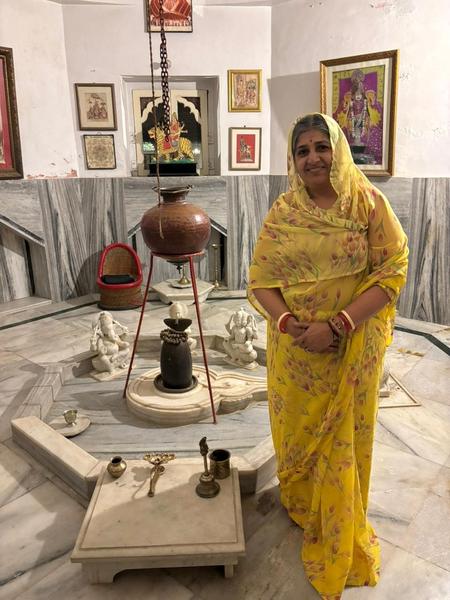
Her day doesn't begin with business meeting. It begins with ancient, rhythmic echoes of her Shiva temple. Just like legendary Ahilyabai Holkar, Thakurain’s morning is elaborate ritual of devotion. In quiet presence of Mahadev, she finds strength to be what she is: woman as comfortable presiding over palace as she is milking cow.
Failure that saved legacy
Story of her grounded life is rooted in family disaster that occurred decades ago. Her uncle, Purshottam Singh of Amet, tried Mayo College and then Daly College in Indore. He wasn't looking for degree; he was looking for way to exist in world that didn't treat him like king.
He lasted exactly two months.
He was "true royal" in old sense—sheltered, served, and disconnected from common soil. He found he could not bear non-royal life. But instead of hiding exit, he used it as mirror. He looked at niece, Sandhya, and her brothers, and made radical decree: “I will not let you be as fragile as I was.” He decided to carve them into new breed of nobility—ones who could connect, understand, and be like common person.
Cowshed curriculum
While other royal children spent weekends in leisure, Sandhya’s childhood was defined by mandatory tasks. Every Saturday and Sunday, titles were dropped at door of family barn.
“Each of us had a cow, and she was our responsibility,” Sandhya said. “We had to cut grass and provide feed ourselves. Cow didn't care about our ancestors. If we didn't do work, she didn't eat. It taught me very quickly that world doesn't owe you anything because of your name—it only gives back what you personally put in.”
This wasn't just chore; it was philosophy. Purshottam Singh forced siblings to learn every basic task—ploughing fields, cooking meals, providing for livestock—ensuring they were independent long before it was popular slogan.
Holkar spirit in 2026
Parallels to Malwa’s Rajmata Ahilyabai are striking. Both women share "Warrior-Saint" duality: ability to manage complex business empire with calloused hand, while maintaining heart of spiritual surrender.
“There is different kind of confidence when you know you can work land,” she said. “You stop being afraid of future. I always felt that if palaces were gone tomorrow, I could still provide. That is true independence.”
This grounded upbringing trickled down to next generation. Her son, polo player Pratap Singh Kanota, carries same soldier-scholar discipline onto field. He was raised by woman who taught him that true royalty isn't what people call you—it’s how hard you’re willing to work for people around you.
Message for modern soul
In world of "fast" success and digital shortcuts, Sandhya Chundawat is breath of fresh air for readers. She is reminder that greatest legacy parent can leave is not bank account, but dignity of labor.
“You cannot truly understand people who work for you if you’ve never stood in their shoes,” she explained. “When I see someone in fields, I don't see servant—I see version of myself at sixteen. If you can’t lead with your hands, you can’t lead with your heart.”
Tina’s Editorial Note: Thakurain Sandhya Chundawat is living proof you can be queen and commoner at exact same time. Her uncle’s struggle to adapt wasn't failure—it was birth of her lifelong strength.