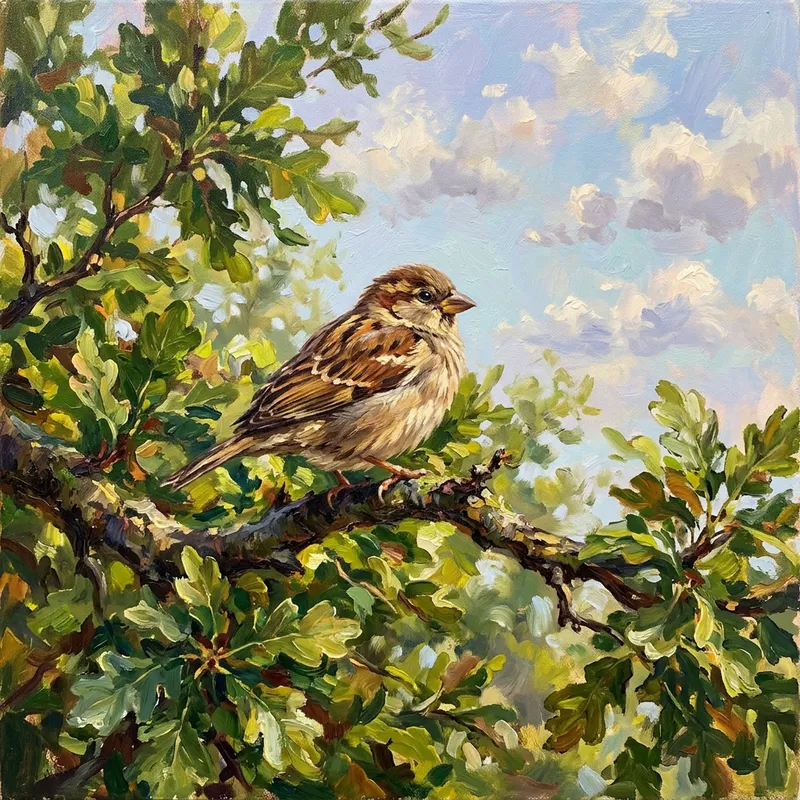
Sophie the Sparrow and the Mango Tree
Welcome to a complete English learning activity built around a warm animal story.
This resource brings reading comprehension, vocabulary, spelling, sentence building, grammar, moral reasoning and creative writing together in one place. The activities are designed to move from understanding the story to thinking about it, using language accurately and finally creating original writing.
The story has an Indian village setting and a gentle folktale-like moral, making it a useful choice for independent learning, classroom practice, revision, family learning or extra English practice at home.
How to use it: Read the story carefully, complete the activities directly on the page, check the objective answers, use the model answers when you need help, and save your work before leaving the page.
PART 1 — READING
Sophie the Sparrow and the Mango Tree
Early one summer morning, a little sparrow named Sophie woke up in an old mango tree. The tree stood at the edge of a small village in India. Its branches were covered with green leaves, and tiny mangoes hung from the branches like little green bells.
Sophie loved her tree. Every morning, she sang from the highest branch.
One afternoon, the weather became very hot. The birds flew to the river to drink, but Sophie stayed behind to look after her three tiny chicks.
Suddenly, she noticed a little squirrel sitting sadly under the tree.
“What happened?” asked Sophie.
“I cannot reach the river,” replied the squirrel. “My leg hurts, and I am very thirsty.”
Sophie looked at the river. It was far away.
“I will help you,” she said.
She flew to a nearby clay pot outside a village house. The pot had a little water left inside. Sophie picked up a small leaf and carried it to the squirrel. Then she made several trips until the squirrel had enough water to drink.
“Thank you, Sophie,” said the squirrel. “You were kind even though you were busy looking after your chicks.”
Just then, dark clouds appeared in the sky. A strong wind began to blow.
“Oh dear!” cried Sophie. “My chicks!”
The wind shook the mango tree. Sophie flew quickly back to her nest, but the nest had become loose.
The squirrel saw what was happening.
“Do not worry!” he called.
He gathered soft grass and strong little twigs from the ground. Soon, other animals came to help too. A rabbit named Ruby brought dry leaves, and a myna bird named Milo carried pieces of grass.
Together, they repaired Sophie’s nest before the rain began.
Sophie looked at her friends and smiled.
“Today I helped you, and now you have helped me,” she said.
The squirrel nodded. “Kindness always finds its way back.”
From that day on, the animals of the mango tree looked after one another. They learned that even the smallest creature can make a big difference.
A kind deed can inspire others to be kind too.
PART 2 — READING COMPREHENSION
A. Remember the Story
Answer in complete sentences.
B. Think About the Story
These questions are intentionally open-ended. Your answer does not need to match the model word for word. Look for the main idea and supporting details.
PART 3 — PUT THE EVENTS IN ORDER
Write 1–6 beside the events.
PART 4 — VOCABULARY
A. Find a Word in the Story
B. Synonyms
Write a word with a similar meaning.
C. Antonyms
Write the opposite.
PART 5 — SPELLING
Correct each word.
PART 6 — SENTENCE BUILDING
Make each sentence more interesting by adding details.
The squirrel ran.
→ The little brown squirrel ran quickly across the dry ground.
PART 7 — GRAMMAR
Choose the correct word.
Join the sentences using because, but, so, or and.
PART 8 — MORAL VALUES
Answer in 2–3 sentences.
PART 9 — CREATIVE WRITING
The Secret Under the Mango Tree
One morning, Sophie discovers a tiny golden box hidden beneath the mango tree.
What is inside?
Who does she tell?
What happens next?
Write 8–10 sentences.
Try to include:
- an interesting beginning
- at least 3 animals
- a problem or mystery
- dialogue
- describing words
- because or although
- a moral or lesson
- a clear ending
Learn From the Story
Reading Skill
When answering a question such as “Why?” or “How?”, try to explain your thinking instead of copying a sentence. A strong answer connects an idea from the question with evidence from the story.
Writing Skill
When expanding a simple sentence, think about who, what, where, when, how and why. Adding precise details makes writing clearer and more interesting.
Spelling Skill
When a word is difficult, avoid simply copying it many times. Look carefully at the tricky part, say the word, cover it, write it from memory, check it and then use it in a meaningful sentence.
Model Answers & Self-Check
Use these answers after you have attempted the activities. Open-ended writing and comprehension questions can have several good answers, so use the models as guidance rather than as the only acceptable response.
Reading Comprehension — Suggested Answers
- Sophie lived in an old mango tree at the edge of a small village in India.
- Sophie stayed near the mango tree to look after her three tiny chicks.
- The squirrel's leg hurt, so he could not reach the river and was very thirsty.
- Sophie carried water from a nearby clay pot to the squirrel using a small leaf and made several trips.
- A strong wind shook the mango tree and made Sophie's nest loose.
- The squirrel, Ruby the rabbit and Milo the myna bird helped repair the nest.
- One possible answer: Sophie was kind and saw that the squirrel needed help.
- The squirrel gathered soft grass and strong little twigs and helped repair Sophie's nest.
- The story teaches that working together helps solve problems and that even small contributions can make a difference.
- One possible answer: The squirrel might have remained thirsty and may not have been able to help Sophie when she needed help.
Put the Events in Order
Answers: 5, 3, 4, 1, 6, 2.
Vocabulary — Find a Word in the Story
- tiny
- thirsty
- chicks
- twigs
- repair
Vocabulary — Synonyms
Possible answers include:
- little — small / tiny
- happy — glad / joyful / cheerful
- quickly — fast / rapidly / swiftly
- kind — caring / gentle / helpful / thoughtful
- strong — powerful / sturdy / mighty
Vocabulary — Antonyms
- hot — cold
- old — new
- strong — weak
- near — far
- little — big / large
Spelling
- sparrow
- squirrel
- beautiful
- because
- friend
- important
- enough
- together
Grammar — Choose the Correct Word
- was
- were
- had
- helped
- flew
Grammar — Joining Sentences
- The squirrel was thirsty, so Sophie helped him.
- Sophie was busy, but she still helped the squirrel.
- The nest was loose, so the animals repaired it.
- The animals worked together, so they finished quickly.
Other grammatically correct combinations may also work if the meaning remains clear.
Moral Values — Possible Ideas
There is no single correct response. A thoughtful answer should explain an action and a reason. For example, someone might safely seek help from a trusted adult when they find an injured bird rather than trying to handle the animal without knowing what to do.
For the friendship question, a suitable response could mention saying thank you, helping the friend in return, writing a kind note or showing appreciation through a thoughtful action.
For the final question, a suitable response could explain that helping others can solve problems, strengthen relationships and encourage kindness in a community.
Creative Writing — What Makes a Strong Answer?
- The story has a clear beginning, middle and ending.
- The golden box creates a genuine mystery or problem.
- At least three animals have meaningful roles.
- Dialogue sounds natural and helps the story move forward.
- Describing words help the reader imagine the setting.
- because or although is used correctly.
- The story contains a clear moral or lesson.
- Spelling, grammar, capitals and punctuation have been checked.