The Lost Puppy Picture Story Worksheet: Who + Doing What + Where/What + When
Learning to make a complete sentence becomes much easier when children can see an action, think about what is happening, and then put the idea into words. This text-free Lost Puppy picture story turns sentence formation into a small story adventure.
The activity is built around one simple sentence formula: Who + Doing What + Where/What + When. Students can watch the picture story, identify the four sentence parts, play a sentence-building game, write their own sentences, check their work, correct mistakes and finally retell the whole story.
Published: October 5, 2026 (IST)
Watch The Lost Puppy Picture Story
Begin with the visual story. Ask the student to watch carefully before writing. Encourage them to notice the characters, actions, place, objects, sequence and time. The images are intentionally designed to carry the story visually, without depending on written text inside the pictures.
Video published October 5, 2026 (IST). Watch the video on YouTube .
What Does the Formula Mean?
A child may understand a picture perfectly but still find it difficult to turn that understanding into a complete sentence. The formula gives the learner a simple path to follow.
Who?
Who is doing something in the picture?
Doing What?
What action is happening?
Where/What?
Where is the action happening, or what person, animal or object is involved?
When?
When is the action happening?
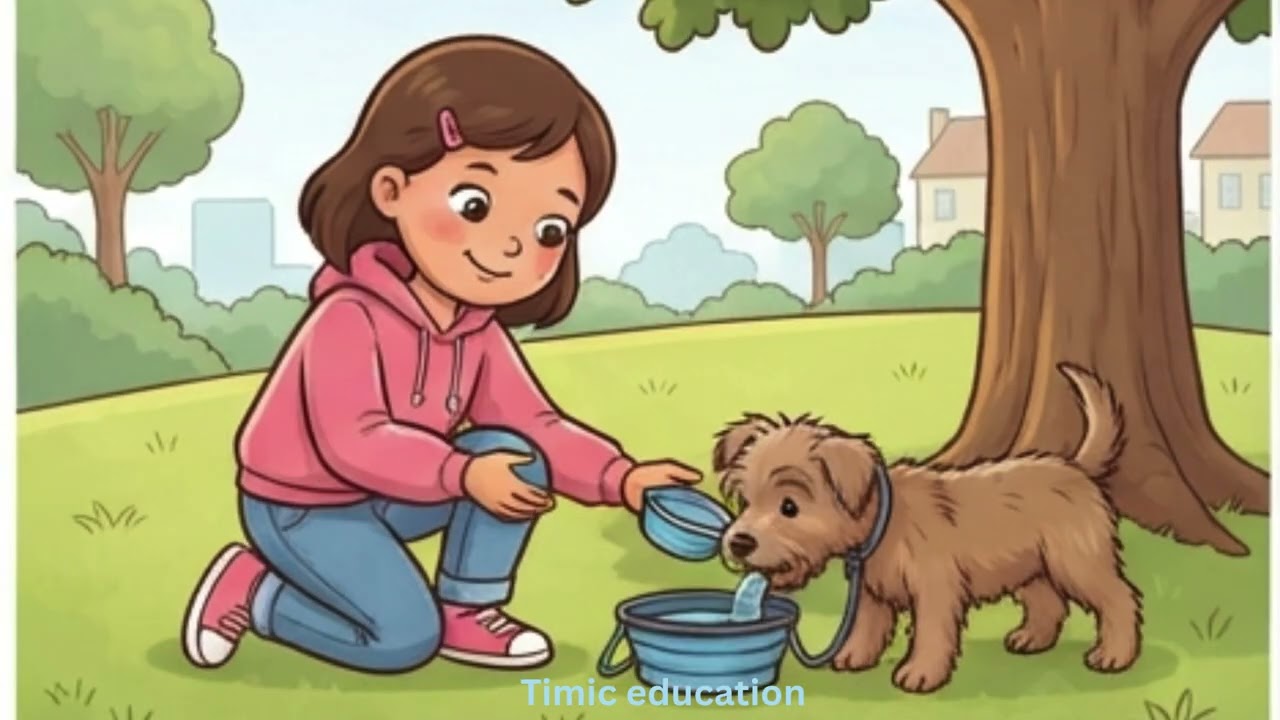
The girl gently gives water to the puppy in the park in the morning.
Who: The girl
Doing what: gives water
Where/What: to the puppy in the park
When: in the morning
Once children are comfortable with this structure, they can gradually make their sentences richer. They can add adjectives, adverbs, feelings, reasons and extra details. But first, a strong basic sentence matters.
The Lost Puppy: The Picture Story
The story follows a young girl who notices a small puppy alone in a neighbourhood park. Instead of ignoring the problem, she decides to help. She gives the puppy water, looks for its owner and eventually helps reunite the puppy with the child who has been searching for it.
The story gives students a clear sequence of actions. That makes it useful not only for sentence writing but also for sequencing, speaking, story retelling, moral reasoning and creative writing.
Picture 1 — A Walk in the Park
A young girl walks through a neighbourhood park in the morning. She is carrying a small backpack.
Picture 2 — Someone Needs Help
The girl notices a small puppy sitting alone under a tree. The puppy appears to need help.
Picture 3 — An Act of Kindness
The girl gently gives the puppy some water. She stays with the puppy instead of walking away.
Picture 4 — Looking for the Owner
The girl looks around the park for the puppy's owner. She is actively trying to solve the problem.
Picture 5 — Finding the Owner
Later that morning, the girl sees a worried boy searching for his puppy. She brings the puppy to him.
Picture 6 — A Happy Ending
The boy happily hugs his puppy while the girl smiles beside them. The puppy is safely back with its owner.
❤️ The Moral
Notice a problem. Take action. Help when you can.
The moral is deliberately active. The girl does not simply feel sorry for the puppy. She notices that something is wrong, gives practical help, looks for the owner and helps solve the problem.
Play First: Build a Sentence
Before asking the student to write, let them experiment with language. Choose one option from each group and build a sentence. Some combinations may sound more natural than others. That is part of the learning.
🎮 Sentence Builder
Choose one answer from every group. Then click Build My Sentence.
1. Who?
2. Doing What?
3. Where/What?
4. When?
Now Write: The Lost Puppy Worksheet
Look at each picture in the collage or pause the video at the appropriate scene. Think first, then write. Use the four questions as your planning space.
1Picture 1
My sentence:
2Picture 2
My sentence:
3Picture 3
My sentence:
4Picture 4
My sentence:
5Picture 5
My sentence:
6Picture 6
My sentence:
Check Your Sentences
Now become your own editor. A good writer does not simply write and stop. A good writer reads, checks, notices problems and improves the sentence.
🔎 Sentence Detective
Find the four clues in this sentence.
The girl gently gives water to the puppy in the park in the morning.
Correct the Mistakes
The sentences below need editing. Can you repair them?
1. Fix the sentence
the girl gives water to the puppy in the park.
The girl gives water to the puppy in the park.
2. Fix the sentence
the boy hugs puppy later that morning
The boy hugs the puppy later that morning.
3. Fix the sentence
girl looks for puppy in the park morning
The girl looks for the puppy in the park in the morning.
🌟 Make Your Sentence More Interesting
Once the basic sentence is correct, add one extra detail. Think about how, what kind, which one or why.
The girl helps the puppy.
More interesting:
The kind girl gently helps the thirsty puppy in the park one morning.
My Improved Sentence
Write a sentence first. Then improve it by adding one useful detail.
❤️ Think About the Moral
The girl could have walked past the puppy. Instead, she noticed the problem and acted.
Think about a time when you helped someone, an animal or even a small creature. What did you do? Why did you decide to help?
My Answer
Tell the Story in Your Own Words
Now look at the six pictures in order. Try telling the story aloud first. Then write your own version below.
My Lost Puppy Story
Teacher and Parent Guide
The best way to use this activity is to resist the temptation to give the sentence immediately. Let the picture do the teaching. Ask questions that help the learner discover the answer.
Useful Prompts
- Who do you see?
- What is the person or animal doing?
- What is the person holding, finding or helping?
- Where are they?
- When is this happening?
- Can you put those ideas together?
- Does your sentence begin with a capital letter?
- Does it end with punctuation?
- Can you read it aloud?
If a learner says, “Girl helps puppy,” first recognise what is correct. Then ask, “Where?” or “When?” This allows the student to expand the sentence independently instead of simply copying the adult's answer.
Move From Support to Independence
At first, use all four prompts: Who? Doing What? Where/What? When?
After a few pictures, remove one prompt. Later, show the picture and simply say: “Make a complete sentence.”
The ultimate goal is not for the child to recite a formula mechanically. The goal is for the structure to become a natural way of organising thoughts before writing.
Model Sentences
These are model answers rather than the only acceptable answers. A child's sentence may use different vocabulary and still be completely correct.
Picture 1
The girl walks through the park in the morning.
Picture 2
The girl notices a small puppy under a tree in the morning.
Picture 3
The girl gives water to the puppy in the park in the morning.
Picture 4
The girl looks for the puppy's owner in the park in the morning.
Picture 5
The girl brings the puppy to the worried boy later that morning.
Picture 6
The boy hugs his puppy while the girl smiles beside them later that morning.
Do not mark a child's sentence wrong merely because it does not match the model. If the sentence accurately describes the picture and is grammatically meaningful, it may be a good answer.
Why Picture Stories Help With Sentence Writing
Picture-based writing gives children something concrete to talk about. Instead of staring at a blank page and wondering what to write, the learner can first observe.
Observation leads to vocabulary. Vocabulary leads to ideas. The four-part formula then gives those ideas a structure.
This makes the activity particularly useful for learners who understand English words but struggle to organise them into complete sentences. The child repeatedly practises identifying a subject, choosing an action, adding relevant information and expressing time.
The same process also supports speaking. Before writing a sentence, the child can say it aloud. This creates an opportunity to notice missing words, awkward word order and incomplete thoughts before putting the sentence on paper.
From Sentences to a Story
Six individual sentences can eventually become a connected story. Ask the learner to notice how one event leads to the next.
- The girl enters the park.
- She notices the puppy.
- She helps the puppy.
- She searches for its owner.
- She finds the worried boy.
- The puppy returns safely to its owner.
The learner can then add simple connecting words such as then, after that, later, suddenly, because, so and finally.
This is a natural bridge from sentence writing to paragraph writing and narrative writing.
🏆 Learning Progress
Use the progress tracker as a fun practice indicator. It is not a school grade. It simply shows how much of the interactive page has been completed.
0% complete
Extend the Activity
When the learner is comfortable with the basic formula, try these challenges.
- Remove all four prompts and ask the student to write independently.
- Ask the student to add one adjective to describe a person, animal or object.
- Ask the student to add an adverb describing how the action happens.
- Ask the student to add a reason using because.
- Ask the student to write what happens next.
- Ask the student to retell the story from the puppy's point of view.
- Ask the student to create a different ending.
- Ask the student to invent a title for the story.
Related English Learning Resources
If this activity works well for your learner, continue with other English resources on TinaKhatri.in. The following verified resources move from vocabulary and sentence construction towards editing, reading and longer creative writing.
- English Spelling, Vocabulary, Reading & Writing Worksheet: 20 Essential Words — spelling, vocabulary, reading comprehension, sentence construction, editing and creative writing practice.
- Sophie the Sparrow and the Mango Tree: Interactive Reading, Spelling & Writing Worksheet — a story-based activity combining reading comprehension, vocabulary, spelling, sentence building, grammar, moral reasoning and creative writing.
- Editing, Punctuation, Reading & Narrative Writing Worksheet — useful for moving from basic sentence work into proofreading, punctuation, sensory details, reading and narrative writing.
- Class VII English Writing Workshop: Scene and Main Idea Writing Like an Author — a more advanced writing activity focused on scene creation, main ideas, character writing and creative expression.
- Explore more English learning resources on TinaKhatri.in .
Frequently Asked Questions
What is the sentence formula used in this worksheet?
The main formula is Who + Doing What + Where/What + When. It gives children a simple structure for turning visual information into complete sentences.
What age group is The Lost Puppy worksheet suitable for?
It is particularly useful for young English learners who are beginning to construct complete sentences. Teachers and parents can adjust the difficulty by changing the amount of prompting and the expected length of writing.
Does the child's sentence have to match the model answer?
No. The model answers are examples. Picture-based writing should allow reasonable variation as long as the child's sentence accurately communicates the picture.
Can this activity be printed?
Yes. The page is designed to work as a printable worksheet, with generous writing areas for handwriting.
How can I make the worksheet harder?
Remove the four prompts and ask the learner to write independently. You can also ask the learner to add an adjective, adverb, reason or second sentence.
How can I make it easier?
Work on one part at a time. Ask “Who?” first. Then ask “What is the person doing?” Once those two parts are secure, introduce place and time.
Final Challenge ⭐
Choose your favourite picture from The Lost Puppy story. Write one sentence containing all four parts: Who + Doing What + Where/What + When. Then improve your sentence by adding one extra detail.
My Best Sentence
First try:
Improved sentence:
Keep Learning, Keep Writing
A picture gives a child something to notice. A sentence gives that idea a voice. A story gives those sentences a purpose.
With repeated practice, children can learn to look carefully, identify important details, organise their thoughts and communicate them clearly.
And the lesson of The Lost Puppy goes beyond English: when you notice that someone needs help, do something kind and useful.
🐶 Continue The Story
The interactive features on this page are practice tools. Typed worksheet answers and checklist selections are saved locally in the learner's browser when the Save My Work button is used. They are not submitted to TinaKhatri.in.