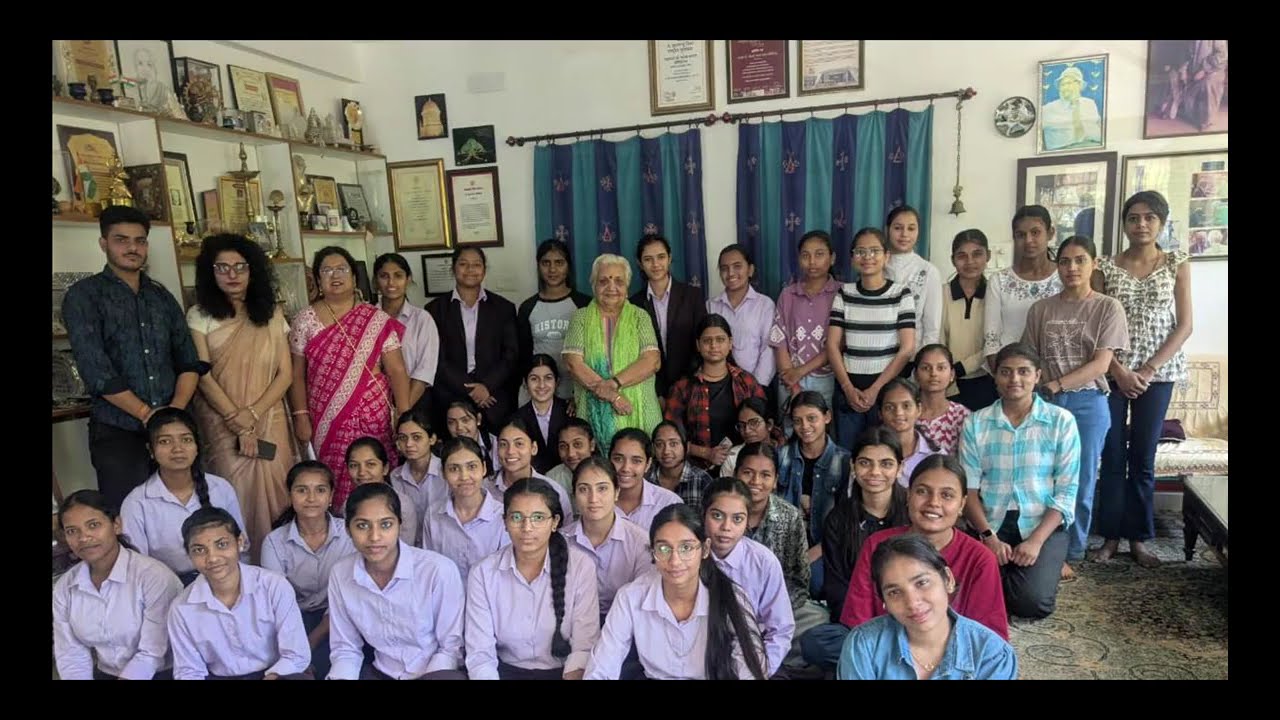
Sunshine, Sustainability and Science: Bio-Science Students Explore Green Living in Indore
From solar-powered cooking and organic farming to medicinal plants and waste management, students of Shri Umiya Kanya Mahavidyalaya, Rau, Indore, explored the practical applications of sustainable development during an educational visit to the Jimmy McGilligan Centre for Sustainable Development. The visit introduced the students to renewable energy technologies, traditional knowledge, natural products and everyday practices that can reduce environmental impact.
The educational visit was organised for B.Sc. Bio-Science students of Shri Umiya Kanya Mahavidyalaya, Rau, Indore. The destination was the Jimmy McGilligan Centre for Sustainable Development, an institution established by Padma Shri awardee and environmentalist Dr. Janak Palta McGilligan, known for her work in sustainable development and environmental conservation.
During the visit, Dr. Janak Palta McGilligan, director of the centre, explained various sustainable technologies and demonstrated their practical applications. The discussions covered renewable energy, solar cooking, medicinal plants, organic products, waste management, composting and environmentally responsible lifestyles.
The students learnt how the careful use of natural resources can help protect the environment, reduce pollution and encourage responsible consumption. The visit also provided an opportunity to understand how scientific principles can be applied outside the classroom.
In this report
- Solar energy and solar cooking
- A hybrid solar and wind power system
- Medicinal plants and traditional knowledge
- Organic products and natural alternatives
- Waste management and fuel briquettes
- Environmental benefits of sustainable living
- Connecting biotechnology with practical learning
- Students share their experiences
- Learning from a sustainable lifestyle
Solar energy and solar cooking: Learning to use the sun
Solar energy was one of the main subjects covered during the visit. Students learnt that sunlight is a renewable source of energy that can be used for cooking, drying food and generating electricity.
They were introduced to different types of solar cookers and learnt about their working principles and applications. These included:
- Box-type solar cookers: These use sunlight and heat retention to cook food inside an insulated enclosure.
- Parabolic solar cookers: These use reflective surfaces to concentrate sunlight towards a cooking point.
- Solar community kitchens: The students learnt about large-scale cooking arrangements equipped with Scheffler dishes, which concentrate direct sunlight for cooking.
These systems offer alternatives to conventional cooking fuels, including firewood, coal and LPG. Their use can help reduce dependence on traditional fuels and limit emissions associated with cooking.
The students also learnt about solar dryers, which use solar heat to remove moisture from fruits, vegetables, herbs and other food materials. Solar drying can help preserve agricultural produce, extend its storage life and reduce food wastage.
A hybrid solar and wind power system supporting tribal families
Another part of the visit focused on a 2 kW hybrid solar and wind power station established by Dr. Janak Palta McGilligan and her late husband, Jimmy McGilligan.
The system combines solar and wind energy to generate electricity. According to the information shared during the visit, the installation meets household electricity requirements and has also been providing free electricity to 50 economically disadvantaged, landless tribal families in the neighbourhood for several years.
The students learnt how decentralised renewable energy systems can contribute to local energy access, particularly in communities where conventional electricity infrastructure or affordability may present challenges.
Medicinal plants, useful vegetation and traditional knowledge
The visit also introduced students to different medicinal and useful plants and their applications in everyday life. They observed plant species used in traditional practices and learnt about their associated properties and uses.
Hadjod and its traditional association with bone health
One of the plants discussed was Hadjod, botanically known as Cissus quadrangularis. The plant is traditionally associated with bone health and is used in certain traditional medicinal practices. The discussion provided students with an opportunity to learn about the relationship between plant biology, traditional knowledge and medicinal applications.
Students also observed plants used for preparing natural hair cleansers and other household products. The use of plant-based materials in personal care was discussed as an alternative to some commercially manufactured products.
Lemongrass, Kadamb and useful plants
The students were introduced to lemongrass and the Kadamb tree, along with other useful plant species. They learnt about their everyday applications and their place in traditional practices.
The centre also introduced them to indigenous grains and spices. These included Sona Moti wheat and Panch Masala, a traditional blend of five spices.
Such examples helped students understand the importance of preserving traditional plant varieties, indigenous agricultural knowledge and biodiversity.
Organic products and natural alternatives
Another area of learning was the preparation and use of products made from natural and plant-based materials. The students were introduced to alternatives that can be used in household cleaning, personal care and food preparation.
Natural floor cleaners and organic phenyl
The students learnt about plant-derived substances used in certain cleaning products, including natural floor cleaners and organic phenyl. These products demonstrate how selected natural ingredients can be used in household cleaning applications.
Herbal tea made from lemongrass
The preparation of herbal tea using lemongrass and other herbs was also discussed. Students learnt about the use of locally available plants in preparing herbal beverages.
Reetha as a natural hair cleanser
Reetha, also known as soapnut, was introduced as a natural hair-cleaning material. Its saponin content makes it useful for traditional cleansing applications.
Composting kitchen and garden waste
The students also learnt how organic waste from kitchens and gardens can be converted into nutrient-rich compost. This process allows biodegradable waste to be returned to the soil rather than being discarded.
Composting also reduces the quantity of organic waste sent for disposal and supports nutrient recycling in gardens and agricultural spaces.
Waste management and fuel briquettes from discarded materials
Waste management was another important subject demonstrated at the centre. Students observed the preparation of fuel briquettes using waste paper and agricultural residues such as straw.
They learnt that materials which might otherwise be discarded can be processed into compact fuel briquettes. This approach illustrates the potential of waste reuse and resource recovery.
The demonstration also highlighted the importance of responsible waste segregation, recycling and reducing dependence on disposable materials.
A campus approach to reducing waste
The centre's approach to sustainable living included a zero-waste lifestyle, a plastic-free environment and reduced dependence on chemical-based products. The students learnt about the idea of living without a conventional trash bin by minimising waste at its source, reusing materials and ensuring that different waste streams are managed responsibly.
This approach encouraged them to consider how daily consumption choices affect the environment and how waste reduction can begin at the individual level.
Environmental benefits of adopting a sustainable lifestyle
The visit helped students understand several environmental benefits associated with sustainable practices. The major lessons discussed during the visit included the following.
1. Conservation of natural resources
Reducing unnecessary consumption of water, energy and raw materials helps conserve resources for present and future generations. Responsible use of available resources is an important part of sustainable development.
2. Reduction in pollution
Using appropriate renewable energy technologies can reduce dependence on conventional fuels. Solar cooking, solar electricity and other renewable energy applications can contribute to reducing pollution associated with traditional energy sources.
3. Zero-waste and plastic-free living
Reducing waste generation, avoiding unnecessary plastic consumption, reusing materials and choosing alternatives to disposable products can help limit the amount of waste entering the environment.
4. Preservation of biodiversity
Tree plantation and the conservation of useful plant species support biodiversity. Protecting plant varieties and natural habitats also helps maintain ecological balance.
5. Sustainable agriculture
Composting, responsible use of agricultural residues and better management of natural resources can support sustainable agricultural practices. Returning organic matter to the soil also contributes to nutrient recycling.
6. Energy conservation
Solar cookers and solar dryers demonstrate how renewable energy can reduce the need for conventional energy sources in certain applications. Using energy efficiently is another important aspect of environmental conservation.
7. Environmental awareness
Understanding the environmental consequences of everyday activities can encourage people to adopt responsible habits. Small steps such as switching off unused electrical appliances, saving water and avoiding unnecessary purchases can contribute to resource conservation.
8. Preservation of traditional knowledge
The use of indigenous grains, traditional spices, medicinal plants and natural household materials demonstrated the continuing relevance of traditional knowledge. Understanding such practices alongside scientific research can support the responsible use of biological resources.
Connecting biotechnology and classroom learning with practical applications
For B.Sc. Bio-Science students, the educational visit provided an opportunity to connect theoretical knowledge with practical applications in environmental science and sustainable development.
The different demonstrations helped students understand how biological sciences are connected with agriculture, renewable resources, plant-based products, waste management and environmental protection.
The observation of medicinal plants provided an opportunity to consider plant identification, botanical characteristics and traditional applications. The discussion of composting introduced the importance of organic matter decomposition and nutrient recycling.
Similarly, the preparation of natural products demonstrated how biological materials can be used in everyday applications. The discussion of agricultural residues and waste management helped students understand resource recovery and the environmental importance of reducing waste.
Renewable energy technologies also showed how scientific knowledge can be applied to address practical environmental and energy-related challenges.
The visit therefore offered students an opportunity to look beyond textbook concepts and understand how science, technology and traditional practices can contribute to sustainable development.
Students share their experiences after the visit
Following the educational visit, students shared their observations and explained what they had learnt at the centre. Their responses reflected an interest in renewable energy, natural products and environmental conservation.
"I learnt about solar cookers during the visit and developed an interest in understanding how they function."
Tanishka Chauhan"I would like to learn more about organic products and understand their benefits."
Pooja Sharma"The visit helped me understand how dependence on conventional electricity can be reduced by making use of natural and renewable energy sources."
Rishi"I learnt many new things related to nature and the environment."
KhushiThe students' responses highlighted the different areas of learning that had attracted their attention, from the working of solar cookers to the practical use of organic products and renewable energy.
A sustainable home offers lessons beyond its walls
The visit to the environment-friendly home of Dr. Janak Palta McGilligan provided students with an opportunity to observe sustainable practices in everyday life. The students learnt that environmental conservation does not depend only on large-scale projects or technological developments. It can also begin with individual decisions about energy use, waste generation, water consumption and the use of natural resources.
Expressing her gratitude after the visit, Lavina Umale said that visiting the home of Dr. Janak Palta McGilligan had been an educational experience. She noted that the lifestyle and commitment to sustainability demonstrated during the visit showed how practical, everyday choices could contribute to protecting nature.
Lavina Umale said: "The home is not simply a building; it is a living example of harmony between human beings and nature. By adopting sustainable practices today, we can help create a cleaner, greener and healthier planet for future generations."
The educational excursion also reinforced the importance of small individual efforts such as reducing waste, planting trees, reusing materials, conserving energy and avoiding unnecessary consumption.
Overall, the visit encouraged students to understand sustainable living as a combination of scientific knowledge, responsible resource management and traditional practices. It also demonstrated how environmental awareness can be translated into practical action in homes, educational institutions and communities.
For the students of Shri Umiya Kanya Mahavidyalaya, the experience connected their academic learning with real-life examples of renewable energy, organic farming, biodiversity conservation and waste management. The visit showed how science and traditional knowledge can work together in addressing environmental concerns and supporting more responsible ways of living.
Key takeaways from the educational visit
- Solar energy can be used for cooking, drying food and generating electricity.
- Hybrid renewable energy systems can support household and community electricity needs.
- Medicinal and useful plants have applications in traditional practices and natural products.
- Composting helps convert biodegradable waste into useful soil nutrients.
- Waste paper and agricultural residues can be considered for resource recovery and fuel briquette production.
- Reducing plastic use and unnecessary consumption can help minimise waste.
- Practical environmental education helps students connect biological science with sustainable development.
How sustainable are your daily habits?
Use this simple checklist to identify everyday actions that can help reduce your environmental footprint. Select the practices you already follow.
You have selected 0 out of 8 sustainable practices.
About the educational visit
Institution: Shri Umiya Kanya Mahavidyalaya, Rau, Indore
Course: B.Sc. Bio-Science
Place visited: Jimmy McGilligan Centre for Sustainable Development
Director: Dr. Janak Palta McGilligan
Report submitted by: Lavina Umale, Assistant Professor, Bio-Science, Shri Umiya Kanya Mahavidyalaya, Rau, Indore.
About the report
This news report is based on the information and account of the educational visit submitted by Lavina Umale, Assistant Professor, Bio-Science, Shri Umiya Kanya Mahavidyalaya, Rau, Indore.
The report covers the learning activities, demonstrations and student responses described in the submitted account.
Watch the educational visit
Watch the video to learn about the students' visit to the Jimmy McGilligan Centre for Sustainable Development, Indore.
Further information and references
Readers interested in sustainable development, renewable energy and environmental conservation can explore the following official resources:
- Ministry of New and Renewable Energy, Government of India for information on renewable energy programmes and solar technologies.
- Ministry of Environment, Forest and Climate Change for environmental policies, biodiversity and conservation initiatives.
- Food and Agriculture Organization of the United Nations for information on sustainable agriculture, food security and natural resource management.
- United Nations Sustainable Development Goals for information on global sustainability objectives.
Editorial note: The descriptions of the centre's facilities, renewable energy installation, products and activities are based on the information supplied in the original institutional report. Traditional medicinal uses mentioned in this article are presented as traditional associations and should not be interpreted as medical advice or established clinical evidence.