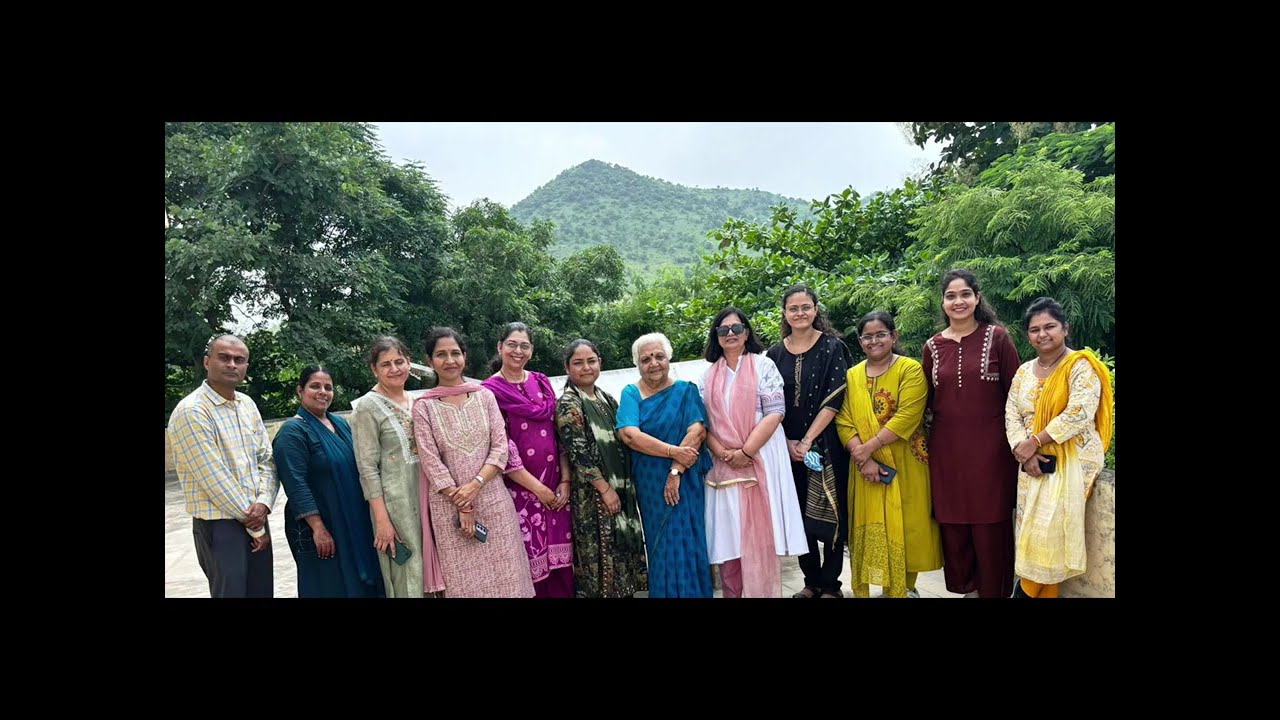
Computer Science Faculty Learn Sustainable Living Practices from Janak Palta McGilligan
A group of faculty members from the Department of Computer Science at Acropolis Institute of Technology and Research, Indore, visited the Jimmy McGilligan Centre for Sustainable Development to learn and understand sustainable living practices.
The visit offered the faculty members an opportunity to move beyond theoretical discussions about sustainability and observe practical, everyday applications of environmental principles. The interaction brought together education, technology, renewable energy, biodiversity, traditional knowledge and community service in one immersive experience.
Learning Sustainable Living at the Jimmy McGilligan Centre
After welcoming the group and a brief introduction, the Centre's Director, Dr. (Mrs.) Janak Palta McGilligan, took them around to her biodiversity farm.
There, she showed the flowers, fruits, vegetables, flora, and fauna. She shared the concept of sustainable living that she and her husband, late Mr. Jimmy McGilligan, had prioritized, including the five elements of nature—earth, water, fire, and air—while constructing the house.
She pointed out that the windows were designed to be large enough to eliminate the need for artificial lighting during the day, while the surrounding trees ensured a pleasant temperature and good ventilation.
Demonstrating Renewable Energy in Everyday Life
Subsequently, she conducted live demonstrations of various simple yet advanced and efficient technologies based on natural resources; these technologies utilize diverse forms of renewable energy in perfect harmony with nature.
Accompanied by Dr. McGilligan, the faculty members viewed ten different types of solar cookers—representing global designs in solar thermal technology—for the first time and received information on solar cooking, baking, and deep-frying.
The demonstrations provided a practical perspective on how renewable energy can be used not only to generate electricity but also for everyday activities such as cooking and food preparation.
Key Learning Areas During the Visit
• Biodiversity: Faculty members explored flowers, fruits, vegetables, flora and fauna at the biodiversity farm.
• Sustainable architecture: The house demonstrates how natural light, ventilation and surrounding trees can reduce dependence on artificial systems.
• Renewable energy: The Centre demonstrates technologies based on natural resources and renewable energy.
• Solar thermal technology: Faculty members observed ten different types of solar cookers representing designs from around the world.
• Solar cooking: Demonstrations included solar cooking, baking and deep-frying.
• Zero-waste living: The visitors learned about a lifestyle focused on reducing waste, chemicals and plastic.
• Community service: The Centre has been providing free street lighting to 50 tribal families in the neighbourhood for the past 15 years.
A Self-Reliant Centre Powered by Renewable Energy
They were amazed to learn that the Centre is not only self-reliant, operating on just 2 kilowatts of combined solar and wind energy, but she has also been providing free street lighting to 50 tribal families in the neighborhood for the past 15 years.
This aspect of the visit highlighted the connection between sustainability and community welfare. Renewable energy was presented not simply as an environmental technology, but as a practical resource capable of supporting everyday life and helping communities.
The Centre's approach demonstrates how relatively simple technologies can be integrated into a broader philosophy of self-reliance, conservation and service.
Dr. Shilpa Bhalerao: Sustainability as a Conscious Choice
Dr. Shilpa Bhalerao, Head of Department, described the visit as a privilege and spoke about the value of meeting Padma Shri Dr. Janak Palta McGilligan and hearing about her journey firsthand.
Dr. Bhalerao said the faculty members were able to learn about the real-world applications of her sustainable lifestyle. According to her, the visit offered a rare opportunity to see how environmental principles can be effectively implemented in homes, educational institutions, industries, and communities wherever needed.
She further observed that Dr. Janak Palta McGilligan's life's work demonstrates that sustainability is not merely an alternative lifestyle but a conscious choice that fosters a healthy planet and a more responsible society.
From Environmental Principles to Real-World Applications
One of the most significant aspects of the visit was the opportunity to see sustainability as something practical and achievable. Instead of being limited to discussions about environmental challenges, the faculty members were able to observe examples of how natural resources, renewable energy and ecological thinking can influence everyday decisions.
The experience also has particular relevance for educators. Faculty members working in computer science and technology are increasingly connected to conversations about energy consumption, responsible innovation, sustainable infrastructure and the environmental impact of modern systems.
A visit such as this can encourage educators to consider sustainability not as a subject belonging exclusively to environmental sciences, but as a principle that can be integrated across disciplines.
Zero-Waste Living and a Deep Connection With Nature
Dr. Bhalerao highlighted what she described as one of the most admirable aspects of Dr. Janak Palta McGilligan's lifestyle—her total commitment to zero-waste living.
She noted that her home is free of chemicals and plastic, while also expressing admiration for Dr. McGilligan's profound knowledge of nature, plants and trees and her lifelong, deep connection with the environment.
The philosophy reflects a broader understanding of sustainability in which human wellbeing is connected to the wellbeing of other living beings and the natural systems around us.
26 Years of Service to Women in Tribal Areas
Dr. Bhalerao also referred to Dr. Janak Palta McGilligan's 26 years of service to women from tribal areas. She noted that Dr. McGilligan continues to share her experiences with more than 187,430 people at the Jimmy McGilligan Centre.
For the visiting faculty, this combination of service, environmental knowledge and practical sustainability created an experience that extended well beyond a conventional institutional visit.
Dr. Bhalerao described the clarity of Dr. McGilligan's thoughts, her positive energy and her constant smile as truly remarkable.
Body, Mind and Soul: A Holistic Approach to Sustainability
During the interaction, Dr. Janak Palta McGilligan beautifully articulated her philosophy of sustainable living: “Life becomes sustainable only when the body, mind, and soul are in harmony.”
This perspective expands the idea of sustainability beyond energy, waste and natural resources. It places personal wellbeing, mental balance and a sense of responsibility alongside environmental stewardship.
For educators, such a holistic approach can be particularly meaningful. Sustainability education is not only about explaining climate change or renewable energy. It can also encourage students and communities to think about consumption, responsibility, wellbeing, cooperation and the long-term consequences of everyday choices.
Technology and Sustainability: A Valuable Lesson for Computer Science Faculty
For the Computer Science faculty members from Acropolis Institute of Technology and Research, the visit offered an unusual opportunity to view technology from a different perspective.
Modern technology is often associated with sophisticated digital systems, computing infrastructure and advanced engineering. At the Jimmy McGilligan Centre, however, the visitors encountered another form of innovation—technology designed around natural resources, efficiency, renewable energy and harmony with the environment.
The solar cookers, renewable energy systems, natural ventilation and passive use of daylight demonstrate that innovation does not always have to mean greater complexity. Sometimes, the most effective solution can be one that works with nature rather than against it.
Community Benefit at the Heart of Sustainability
The story of the Jimmy McGilligan Centre also demonstrates how environmental action can extend into community service. The Centre's provision of free street lighting to 50 tribal families in the neighbourhood for the past 15 years shows how renewable energy can be connected to social benefit.
This community dimension is important because sustainable development is ultimately about people as well as the planet. Technologies become more meaningful when they improve access, reduce dependence on conventional resources and create tangible benefits for communities.
The visit therefore offered the faculty members an opportunity to see sustainability through several interconnected lenses—environmental protection, technological innovation, education, community service and personal responsibility.
What the Faculty Took Away From the Visit
Dr. Bhalerao said the experience left a deep impression on the visiting group. Meeting Dr. Janak Palta McGilligan and observing her lifestyle gave the faculty members an opportunity to understand how environmental principles can be implemented in real settings.
The experience also demonstrated the value of learning directly from practitioners whose work combines knowledge with decades of action. From biodiversity and renewable energy to traditional cooking and community service, the Centre presented sustainability as a lived experience rather than merely a theoretical concept.
For teachers, such encounters can also become a source of inspiration for bringing sustainability conversations into educational institutions and encouraging students to think creatively about the relationship between technology and the natural world.
A Message of Gratitude
Concluding her reflection on the visit, Dr. Shilpa Bhalerao thanked Dr. Janak Palta McGilligan for her affection, kindness and willingness to share valuable insights with the faculty members.
The visit to the Jimmy McGilligan Centre for Sustainable Development ultimately offered the Computer Science faculty a reminder that sustainability can be practiced in everyday life. From the way a home is designed and energy is generated to the way food is cooked, waste is reduced and communities are supported, environmental responsibility can be built into ordinary choices.
In that sense, the Centre functions not only as a place to learn about sustainable living, but also as a living example of how ecological values can be translated into action.
About the Jimmy McGilligan Centre for Sustainable Development
The Jimmy McGilligan Centre for Sustainable Development is associated with the work and sustainable living philosophy of Padma Shri Dr. Janak Palta McGilligan and her late husband, Mr. Jimmy McGilligan. The Centre brings together biodiversity, renewable energy, sustainable living practices, environmental learning and community-oriented initiatives.
The Indore Insider
The Indore Insider is a dedicated space for insights on education, heritage, culture, environment, civic issues and English learning, as well as the people and stories shaping Indore and Madhya Pradesh.
Led by Tina Khatri, School Coordinator for FP School, this blog bridges the gap between classroom news and community stories—from educational developments to environmental initiatives, cultural milestones and inspiring personal journeys.
I’m Tina Khatri—journalist, educator, and observer. This blog is a collection of news, art, and personal journeys.