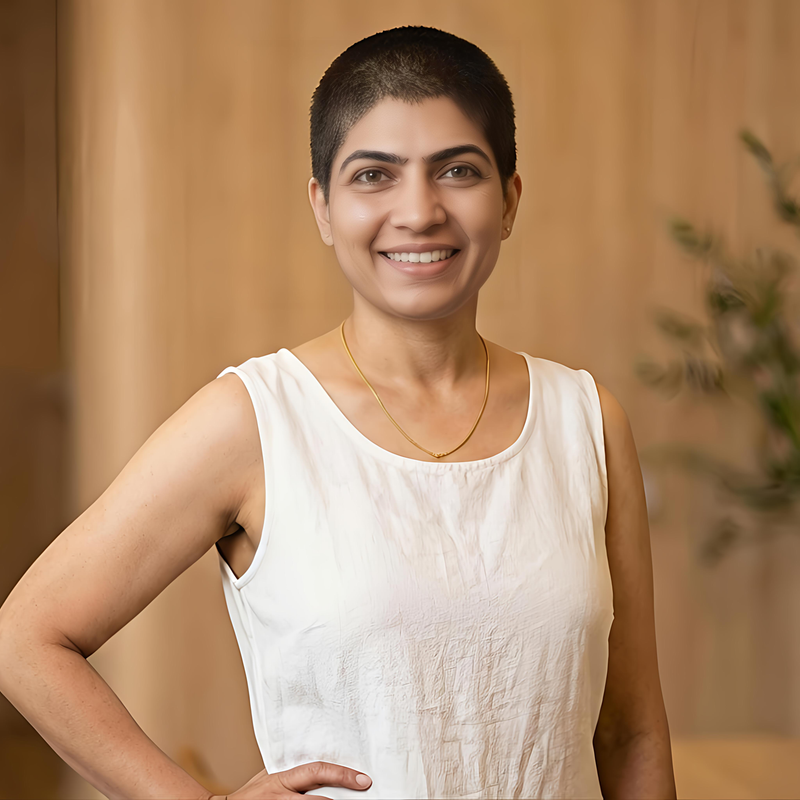
Janak Palta McGilligan: The Punjabi Bride Who Chose Her Widowed Aunts to Bless Her Wedding
She was a Punjabi-born woman who embraced the Bahai faith, a bride who wanted her widowed aunt to perform her haldi and her widowed maternal aunt to place her chooda. Years later, Padma Shri Janak Palta McGilligan would become known for empowering rural women and championing sustainable living. But as we explore through our community reporting and local change initiatives, the story of her courage begins much closer to home, in the family traditions she chose to question.
Before the Padma Shri. Before the years spent working with rural and tribal women. Before the solar cookers, the lessons in sustainable living and the institution that would become synonymous with her life's work, there was a young Punjabi woman who had a very personal question to ask her family.
Who would be allowed to bless her wedding?
In a heart-touching interview, Janak Palta McGilligan recalled the decision she made for her wedding. Her parents asked her which rituals she wanted to follow. She knew what she wanted. She would not automatically accept customs that she believed were unfair to women.
She wanted her widowed paternal aunt to perform the haldi, the oiling ritual. She wanted her youngest maternal aunt, also a widow, to put on her chooda.
Her parents supported her.
There is something quietly extraordinary about that memory. Not because a wedding needs to become a battlefield, or because every inherited custom must be discarded, but because a young woman recognised an injustice in a place where love was supposed to be gathering everyone together.
Imagine the familiar scene at a North Indian wedding. The preparations are underway. Turmeric and oil are ready. Relatives are waiting to take their turn. Someone announces that married women should come forward to bless the bride.
Now imagine being a woman who has lost her husband. You are still somebody's sister. You are still somebody's aunt. You have loved, worried, worked, laughed, suffered and survived. You have watched the bride grow up. You have affection to offer her.
And yet a custom may tell you that your presence does not belong in this particular moment of happiness.
That is the contradiction Janak's decision challenged.
Her story deserves to be read slowly, because the act itself was intimate. She did not need to make her widowed aunts symbols of a social movement. They were family. She wanted them beside her. She wanted their hands to participate in the rituals that marked the beginning of her married life.
In a country where customs surrounding widowhood have sometimes restricted women's clothing, jewellery and participation in celebrations, that choice carries a larger meaning. It asks why a woman should be made to carry a social penalty for a loss she did not choose.
And it asks another question, just as important: if a tradition is meant to convey love, should it not make room for every person who comes with love to offer?
- The wedding ritual she chose to change
- What Janak said about widowhood and equality
- Punjabi roots and the Bahai path
- The young woman searching for a purpose
- Building Barli and empowering rural women
- Jimmy McGilligan, love and loss
- The discipline of sustainable living
- A Navratri reflection on dignity
The Wedding Ritual She Chose to Change
Janak explained that she had seen the treatment of widowed women from a young age. She remembered relatives who were made to sit apart from the festivities and were excluded from moments of family happiness.
One memory stayed with her. A young widowed paternal aunt was not even given soap by her mother-in-law. It was an ordinary object, something most people would never think twice about buying. Yet its absence revealed how completely a woman's needs and dignity could be pushed aside after her husband's death.
There is no grand spectacle in that memory. There is simply a woman who needed something as basic as soap, and a social environment in which even that need could be neglected.
That is often how discrimination survives. Not only through public declarations or written rules, but through small everyday practices that people stop noticing. A woman is seated in a corner. She is left out of a celebration. A simple kindness is withheld. A custom is followed because questioning it would be uncomfortable.
Janak saw these things and began asking herself what could be changed.
When her parents asked which wedding rituals she wished to observe, she made her choice clear. Her widowed paternal aunt would apply the haldi. Her youngest maternal aunt, who was also widowed, would put on her chooda.
These were not symbolic strangers invited to make a point. They were the women she wanted to include in her wedding.
In her interview, Janak shared that her parents consistently took her views seriously. That support is an important part of the account. The decision belonged to the bride, but her family's willingness to listen allowed it to become part of the ceremony.
Imagine what a young person learns when her parents respond to a difficult question with attention instead of dismissal. She learns that affection and disagreement can exist in the same room. She learns that family traditions can be examined without treating the family itself as an enemy.
And imagine what a younger relative might learn by watching a widowed aunt come forward to bless the bride. She sees that widowhood does not cancel a woman's place in her family. She sees that a person's capacity to offer love is not determined by whether her husband is alive.
That is the lasting significance of Janak's wedding decision. It is a personal act that invites other families to reconsider the rules they have inherited.
What Janak Said About Widowhood and Equality
Janak's reflections went beyond her wedding. She spoke about what she had observed as a child, including the exclusion of widowed relatives and discrimination among women from different caste backgrounds.
She explained that she began trying to change these attitudes within her own family when she was very young.
Her response was to begin with small changes at home. She recalled eating from the plate of a woman who lived near her family and inviting children from communities facing caste discrimination to family meals.
She described these as small actions, but their meaning was considerable. A plate can become a boundary. A meal can become a test of who is accepted. A child's invitation to sit and eat can challenge a prejudice that adults have allowed to pass from one generation to another.
Janak's approach was not to wait until she held a position of authority. She began where she had influence: within her own household and the relationships immediately around her.
That decision connects the wedding ritual to a wider philosophy. Social change does not always begin with a campaign, an institution or a public speech. It can begin when someone refuses to participate in an everyday exclusion.
In the same conversation, she reflected on the responsibility women have towards one another. Her point was that discriminatory customs associated with women are often also maintained by women. If women stand up for equality, she argued, those practices can be challenged.
The thought is uncomfortable in a useful way. It asks us not merely to condemn discrimination when it is imposed by someone else, but to examine the customs we ourselves may be helping to preserve.
It asks mothers, aunts, grandmothers and daughters what they want the next generation to inherit. It asks whether a woman who has already endured the pain of losing her partner should also have to endure exclusion from the ordinary happiness of her family.
It asks whether a ritual can become more compassionate without losing its cultural identity.
Jadon aurtaan ik duje de naal kharhdiyaan han, taan bhedbhaav di deewar kamzor hon lagdi hai.
English translation: When women stand beside one another, the walls of discrimination begin to weaken.
This is an original editorial translation celebrating the spirit of sisterhood.
Punjabi Roots and the Bahai Path
Janak Dulari Palta was born in Jalandhar, Punjab, on February 16, 1948. She grew up with a Punjabi cultural inheritance and later embraced the Bahai Faith, a distinct world religion whose teachings emphasise the oneness of humanity and the equality of women and men.
Her identity should not be reduced to a contrast between one faith and another, or between modernity and tradition. Her wedding story is more personal than that. She was a Punjabi daughter making decisions about her own marriage, guided by her convictions and supported by her parents.
She often explained the influence of spiritual teachings on her understanding of equality using the beautiful image of a bird with two wings: both wings must work together for the bird to fly.
The image makes equality something more practical than a slogan. One wing cannot be dismissed as less important and still expect the bird to fly properly.
Likewise, a society cannot claim to value women while restricting their education, independence or participation in family and public life.
For Janak, these beliefs were not confined to religious reflection. They became part of the choices she made, the institution she built and the work she undertook with rural and tribal women.
Her wedding is a particularly intimate example. She did not have to abandon every ritual associated with her Punjabi background. She chose the rituals she wanted and refused the restrictions she believed were unfair.
That distinction matters. Traditions can provide continuity, belonging and emotional meaning. But a custom should not become immune to questions simply because it has been practised for generations.
Families can retain the gestures that bring them together while reconsidering the practices that leave some members outside the circle.
Janak's parents listened to her. Their response reminds us that a family can support a young woman's convictions without treating her questions as an attack on her upbringing.
The Young Woman Who Searched for a Purpose
Long before her work became widely recognised, Janak experienced a medical crisis that changed the way she thought about life.
At sixteen, she underwent open-heart surgery. Reflecting on the search for purpose that followed her survival, she shared what drove her forward.
There is a quiet clarity in those words. She did not describe gratitude as something that ended with the knowledge that she had survived. She wanted to turn it into a way of living.
What does a person do with a life she has been given? What does gratitude look like when it becomes action? How does a private experience become a reason to help other people?
Janak's answer unfolded over decades.
Her education included English literature and political science, followed by research and academic work. She worked as a translator and later took part in research projects, including work connected to communal tensions in Punjab.
Her path eventually brought her to Indore, where she was invited to establish an institute for rural and tribal women. On June 1, 1985, she left her professional life and familiar surroundings in Chandigarh to begin that work.
The land was largely undeveloped. There were no finished buildings waiting to welcome a new institution. The work had to begin from the ground up.
She described the journey in words that are brief but revealing.
The words do not romanticise the struggle. They acknowledge that the work was difficult while refusing to treat difficulty as proof that it should not be attempted.
That is an important distinction when telling the story of a social worker. Institutions do not grow through inspiration alone. They require resources, planning, relationships, practical knowledge and the patience to continue when progress is slow.
Janak's career would become an example of that sustained commitment.
Building Barli and Empowering Rural Women
The Barli Development Institute for Rural Women became the centre of Janak's work in Indore. Its purpose was to help rural and tribal women develop the knowledge, skills and confidence needed to participate more fully in their communities.
The institute's name carries a metaphor drawn from the Bhilali language. Barli refers to the central pillar that holds up a house.
It is an apt image for an institution focused on women. A pillar supports a structure, often without drawing attention to itself. Its importance becomes clear when we consider what depends on its strength.
Women in rural communities often carry substantial responsibilities for households, food, care and local livelihoods. Yet responsibility does not automatically bring access to education, income, technology or decision-making.
Training and literacy can help address that imbalance. So can practical opportunities to acquire skills, understand health and nutrition, use appropriate technologies and take part in community leadership.
Janak served at Barli for approximately twenty-six years, helping empower thousands of tribal and rural women through vocational education, literacy, health awareness and sustainable development.
The significance of such work lies in what women can do with the learning they acquire. A woman who develops a practical skill may be better equipped to earn an income. A woman who learns to use a solar cooker may reduce her reliance on smoky cooking fuels. A woman who becomes confident in a community meeting may be better placed to speak about a problem affecting her village.
These are different outcomes, and none should be treated as automatic. Development work needs sustained support, suitable technologies and attention to local circumstances. But access to knowledge can create choices where there were previously few.
Janak's work has also connected women's empowerment with environmental responsibility. In communities where women are closely involved in cooking, food preparation and household resource management, practical technologies can have consequences for health, time, livelihoods and energy use.
Her work with Jimmy McGilligan helped extend the use of solar cooking and other sustainable technologies among rural women. The aim was not merely to demonstrate a device. It was to help women learn to use technology in ways that could improve daily life and support livelihoods.
The young woman who had searched for a way to express gratitude through service had built a career around making opportunities more accessible to others.
In 2015, the Government of India awarded Janak the Padma Shri for her contribution to social work, recognising a lifetime of tireless service.
For more information, read the official biography of Janak Palta McGilligan and the Barli Development Institute's awards and recognition page.
Jimmy McGilligan, Love and the Life That Continued
Janak's life also tells the story of a marriage built around companionship and shared work.
Her husband, James R. McGilligan, known affectionately as Jimmy, was an important partner in her work with rural and tribal women. He served as manager of the Barli Development Institute and contributed to efforts involving renewable energy and practical technologies for rural communities.
Their shared life brought personal companionship together with a common commitment to service. Their work was not simply a professional collaboration conducted at a distance. It was part of the life they built together.
Jimmy died in 2011 following a tragic road accident. His death changed the course of Janak's life, but it did not end her commitment to the work they had shared.
The Jimmy McGilligan Centre for Sustainable Development was established to continue work connected to sustainable community development, with Janak carrying the mission forward from Giridarshan in Sanawadiya, near Indore.
Her continuing work should not be mistaken for an absence of grief. Bereavement is not a test that a person passes by remaining productive. A person can continue serving others while carrying the pain of a profound loss.
The profound love she holds for her husband is visible in every dedication she writes.
The phrase is deeply personal. She remembers a partner, a companion in service and a person whose contribution mattered to the work they shared.
It also helps us understand why the story of her wedding belongs in a larger account of her life. Marriage, for Janak, was not simply a ceremony or a status. It was a relationship that shaped her work, her memories and her understanding of service.
Her life after Jimmy's death also challenges the assumption that widowhood should make a woman less visible, less active or less entitled to joy. She continued to work, learn, teach and share the principles that had shaped their life together.
There is a difference between saying that a person has overcome grief and recognising that grief and purpose can coexist. The latter allows a more honest understanding of how people live after loss.
It is also why a widow should never be treated as someone who carries misfortune into a wedding celebration. She is a person whose life has included love, and whose capacity to offer love remains.
Read more about the centre's work on the official Jimmy McGilligan Centre for Sustainable Development website.
The Discipline of Sustainable Living
At Giridarshan in Sanawadiya, Janak's environmental commitment is reflected in daily practices as well as public advocacy.
Her work has involved solar cooking, sustainable technologies, waste reduction, organic food production and environmental education. The Jimmy McGilligan Centre presents sustainable living as something that people can learn and practise rather than merely discuss.
In its environmental reports, the centre highlights Janak's constant emphasis on refusing unnecessary plastic, carrying a steel glass and using a cloth or jute bag.
The word is simple. Its implications are practical. Refuse a disposable item when a reusable alternative is available. Refuse unnecessary packaging. Refuse the assumption that convenience must always take priority over environmental responsibility.
These small decisions cannot, by themselves, solve the environmental crisis. Wider change requires responsible manufacturing, public infrastructure, effective policy and collective participation. But everyday habits matter when they become part of a broader culture of care.
Janak's life has connected these habits with education and community empowerment. The work is about showing people what can be done, explaining why it matters and helping them acquire the skills to put it into practice.
Her example also encourages a more thoughtful approach to consumption. An object does not become worthless because it is old. A garment can carry memories. A household can reduce waste by repairing, reusing and making considered choices about what it buys.
That principle has a natural connection with weddings, which can sometimes involve considerable expenditure and waste. A celebration does not need to become less meaningful because a family chooses to reuse clothing, reduce disposable materials or make environmentally responsible choices.
Nor does a wedding become more auspicious by excluding a woman who has been widowed.
The connection is not that Janak's wedding decision and her environmental work are the same achievement. Rather, both invite us to examine the habits we follow without asking whether they remain useful, humane or responsible.
One question concerns the treatment of people. Another concerns the treatment of the planet. Both begin with the willingness to look carefully at what we do and why we do it.
For more on her environmental work, visit the centre's World Environment Day report.
A Navratri Reflection on Dignity
Navratri brings the feminine divine into the centre of public and private celebration. Across India, families mark the festival through prayer, music, fasting and gatherings. The forms differ, but courage, strength and the defeat of injustice are recurring themes in many of its traditions.
Janak's experience can prompt reflection during Navratri because the questions it raises about dignity, equality and compassion are relevant across communities.
How do we honour women's strength in our prayers while treating the women around us in everyday life?
How do we celebrate the feminine while allowing a widow to be pushed into a corner?
What does equality mean when a woman is welcomed at one family gathering but excluded from another because her husband has died?
It is easy to admire courage when it appears in a grand story. It can be harder to recognise it in a young woman who asks her parents to reconsider a wedding custom, or in parents who decide that their daughter deserves to be heard.
Janak's account offers a reminder that social change can begin in the spaces where people know one another best. A home can reproduce discrimination, but it can also become the place where a different practice begins.
A wedding is one such space. It brings together generations, memories, expectations and hopes for the future. The customs followed at that gathering can teach children who belongs and who does not.
When a family changes an exclusionary practice, it gives the next generation a different example to follow. It shows that tradition can be treated with respect without making every inherited restriction permanent.
The question is not whether every tradition should be rejected. The question is whether the human beings who sustain those traditions are being treated with dignity.
Riwaaj oh hove jo dilan nu jodhe, na ki kise nu khushi ton door kare.
English translation: Let tradition bring hearts together rather than keep anyone away from happiness.
An original editorial reflection on the true spirit of togetherness.
What a Family Can Change Without Losing Its Traditions
Imagine the moment before the haldi begins.
The turmeric is ready. Relatives have gathered. The bride is waiting. The familiar announcement is about to be made, inviting married women to come forward and bless her.
Now imagine the announcement changing.
Let everyone who wishes the bride well come forward.
The ritual remains. The affection remains. The family remains. What disappears is the assumption that a woman's marital history determines whether she can participate in a moment of happiness.
A widowed aunt no longer has to wonder whether she should stay seated. A bride can welcome the women she loves without asking them to justify their presence. A child watching the ceremony can learn that a blessing comes from affection, not from a person's marital status.
This change does not solve every difficulty experienced by widowed women. It does not remove economic insecurity, loneliness or the other pressures that bereavement can bring. It does not transform society in a single afternoon.
But it makes one family ritual more inclusive, and that matters.
Janak's decision is a specific and personal example, showing that a different choice was possible within her family.
Her parents listened. She expressed her wishes. The women she wanted to participate were included in the ceremonies she had chosen.
Sometimes, that is where meaningful change begins: with a person who recognises an injustice, a family willing to listen and a decision that turns a conviction into practice.
The Blessing We Must Not Deny
Return to the two women at the centre of Janak's wedding memory.
Her widowed paternal aunt was the woman she wanted to perform the haldi. Her youngest maternal aunt, also widowed, was the woman she wanted to put on her chooda.
They were not defined only by the men they had lost. They were relatives whose presence mattered to the bride.
That distinction is the emotional heart of this story.
A widow is not a warning about the future. She is not an omen. She is not a reminder that a marriage can end in loss, as though married women themselves are protected from life's uncertainties.
She is a human being. She has known love and grief. She has relationships that continue. She can offer tenderness, wisdom, humour, affection and a blessing to someone beginning a new chapter.
Janak's life offers a wider context for that simple truth. She has spent decades working to expand opportunities for rural and tribal women. She has continued her environmental work after losing Jimmy. She has carried forward the values of education, equality and service through institutions that help people learn and act.
Her wedding decision should not be romanticised into a claim that one ceremony changed an entire society. It should be recognised for what it was: a deliberate, personal refusal to exclude two women she loved.
That is enough to make us pause.
Because the most meaningful questions are often the simplest. Who gets to participate? Who is made to wait outside? Which customs are we following because they express love, and which are we following because no one has asked whether they are fair?
During Navratri, we may celebrate courage through stories of extraordinary strength. Janak's story brings that idea into the everyday world, where courage can mean questioning an assumption and compassion can mean inviting someone forward.
This Navratri, may every family find the courage to preserve the tenderness of its traditions while letting go of the exclusions that diminish them. May no woman be made to feel that her grief has taken away her place in the lives of those she loves.
And may we remember that a blessing is not made weaker by the hands that have known sorrow. Sometimes, those hands understand its value more deeply than anyone else.
The most beautiful change may be a small one: a bride asking that the women she loves be allowed to bless her, and a family making room for them.
Take a Moment to Reflect
Which small change could make a tradition more inclusive?
Use these prompts for personal reflection or a respectful family conversation.
What does a meaningful tradition look like in your family? Is it meaningful because it has always been followed, or because of the love and dignity it brings to the people who participate? Share your thoughts respectfully and keep the conversation open.